Wednesday, November 2, 2016

Three Joyful Moments

This week is a busy one. Last week was too. (Lately, they all seem to be, honestly...) It's advising season as we prepare for registration for the spring semester, and this means extra meetings.

But amidst all the busyness, three joyful moments for me:

1. I had a hallway conversation with a fellow professor who was once one of my middle school students. (Yep...I'm getting old...that the kids I taught when they were young adolescents are now colleagues of mine? Yikes.) But the conversation was so fantastic: brief, but deeply reflective about the kind of learning environment we want our institution to be for faculty. I wonder sometimes how many colleges and universities think of themselves in that way: a place for professors to continue to learn, to develop, to hone their craft, to grow?

2. During a group advising session last night, one of my junior (3rd year) advisees and one of my freshman (1st year) advisees were talking across the table while waiting for me to come over and talk with them about their 4-year plans. Both are future middle school teachers. As I walked toward them, I overheard the junior said to the freshman something like, "I'm glad it's been a good experience for you so far in Education...but just wait! It gets better!" This made me feel so proud of our program, and the future we are privileged to have a hand in shaping. We start them off well...and they find it just gets better the further they go in their studies in Education.

3. My Elementary Science Methods course is a little odd this semester: I typically have about 20 students, but due to the foibles of scheduling, I only have 5 students taking the course this fall. This has been a wonderfully weird experience for me, and I find I run the course much more like a seminar than a lecture-based course. Today we went far off topic (we often get a little off topic...) because they were asking such great, deep questions about how to get students engaged in learning, and what we can do as teachers to help support them in this. The conversation was so rich that I totally lost track of time, and when I realized that we only had five minutes left, I exclaimed in dismay: I had only taught about a third of my intended lesson plan! But my students--these amazing scholars!--immediately suggested a solution: none of them have a class after our scheduled block on Friday, and they suggested that we plan to stay late on Friday afternoon, to not only participate in the hands-on activities planned for Friday's lab experience, but also to complete the lesson discussion from today.

I am blessed to be part of this place. I am honored to serve alongside these amazing faculty members and to work with students of this calibre.

I have my moments of stress, for sure. I have moments I am overwhelmed by the challenges of professing.

But these joyful moments were a great reminder for me of just how blessed I am to be here.
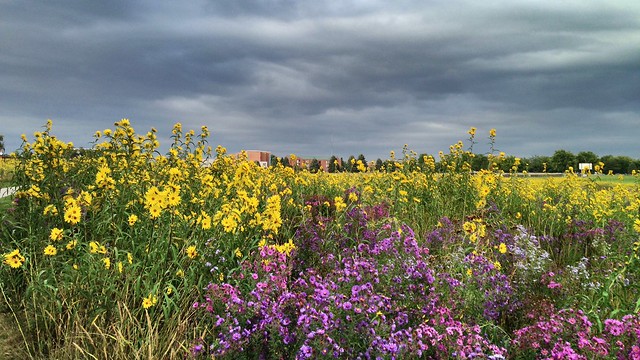
The Prairie at Dordt College, September 22, 2016. Image by Dave Mulder [CC BY-SA 2.0]

Sunday, October 23, 2016

Fear or Love?

Stop it with all the fear-mongering already.

Seriously.

Stop it.

Stop posting and reposting that fear-mongering schlock.

I'm about ready to put my Facebook account on hiatus, because of the ridiculous things people continue to post related to this current election. It's making me not like people who I know in real life, and I'm tired of it all.

So many of my Christian friends are posting about the horrible things that will happen if one major party candidate or the other is elected in November.

I get it. I too have preferences. I have my opinions too, and I believe all educated people should.

But the fear-mongering?

Monday, October 10, 2016

Wondering

I recently came across this quote; like so many, it is attributed to Albert Einstein.
The most beautiful thing we can experience is the mysterious. It is the source of all true art and all science. He to whom this emotion is a stranger, who can no longer pause to wonder and stand rapt in awe, is as good as dead: his eyes are closed.
 (And this one appears to be a legitimate Einstein quote, from an essay in Living Philosophies.)

This is so quotable, isn't it? I sort of want a poster that says this to hang on the wall of my office.

This has me thinking about my role as a Christian educator. How am I making space for my students to "experience the mysterious?" To wonder? To stand in awe?

Would making space for "wondering"--in every sense of the word--bring life to my classroom? What kind of learning atmosphere would result if I sought to include time to wonder in ever lesson I taught? Would students learn more? Would they be more engaged? Would they be more curious? Would they care more deeply about the content? Would they feel like it was a waste of their time? Would it begin to lose it's luster if we "wondered" all the time?

I wonder...


Saturday, October 8, 2016

Opinions: Evidence of Thinking

"Hey, Professor Mulder...is this an opinion question?"

A few semesters ago, I had a student taking a test raise her hand to call me over with this concern. She was in the midst of of the test, doing her best to answer carefully, and the thought must have struck her that there were multiple "correct" answers to the question I was asking.

Not every question I ask on a test is cut-and-dried. Some are. Some questions are convergent: there is clearly one correct answer. Convergent questions are usually best for assessing relatively low-level knowledge and understanding. Can the students recall the facts? Have they mastered the vocabulary? Do they have an understanding of the basic concepts? Convergent questions are good for these sort of course material. By asking a convergent question on an exam, I am verifying that my students have mastered a particular concept. And this is valuable in it's way; there are concepts that I want all of my students to learn, and a convergent question is a way of focusing in on their knowledge of a particular concept.

However, I don't think that convergent questions are always the best questions, even on a test. I want my students to provide evidence of thinking, not just rote memorization. How will they use the basic concepts they have learned? I've written before about Bloom's taxonomy of cognitive objectives. Bloom's taxonomy is one way of thinking about different levels of thinking. Here it is in a nutshell:

Thursday, October 6, 2016

The Problem of Tribalism

A week or so ago, Scott Evans was a guest on the campus where I teach. Scott serves as a chaplain at the University of Dublin in Ireland, and is an author, speaker, thinker, and--by all evidence--a gracious encourager of an authentic faith. (Oh, and he has a pretty amazing beard too.) I was tremendously encouraged and challenged--at the same time, no mean feat--by the message he brought in chapel while was visiting.

It was great having Scott on campus again!

Scott preached on Acts 6-7, which tells the story of the growth of the early church, and the growing pains that they experienced. They didn't always get along well. There were different groups within the Body even then, and it took creative, faithful problem-solving to address the needs of the different groups. Scott challenged us to think about the contemporary church as well, and how we are functioning as a creative, faithful Body. He was far more eloquent than I am making him sound here, I'm afraid. You can watch a recording of his message, if you're interested. (I recommend it!)

Our campus chaplain mentioned that Scott and a couple of fellow Irishmen have a podcast called The Graveyard Shift, and after being so encouraged/challenged (encourochallenged?) by Scott's message, I figured I'd give it a listen.

Oh, I'm SO glad I did.

Wednesday, October 5, 2016

A Tech Tool (Toy?): paperplanes.world

File this under the "how could I use this for a lesson" file... (with thanks to my twitterfriend, Kyle Calderwood, for sharing...)

1. Grab your phone and head over to paperplanes.world. (Seriously, you should do this right now...)

"Hot Ham!" Or, How Our Words Matter

My daughter, who is now a tween, has begun listening to the radio at her own volition. I knew this day would come.

We listen to a lot of music in our house, and many different genres. She gravitates toward pop music, likely swayed by her friends. She recently asked me to change the radio while we were driving someplace to a station that we do not have on one of our pre-set buttons. Now, this is no problem for me, because I actually have a very eclectic taste in music, and I like to talk with my kids about the kinds of music they listen to, and what they like and dislike.

While we were listening, we heard "Wildest Dreams" by Taylor Swift and "7 Years" by Lukas Graham, and then Mark Ronson & Bruno Mars's "Uptown Funk." Now, if you know any of these three songs, you might perceive that there is some potentially problematic content for a tween in any of them. So far as I can tell, much of it is flying over her head yet, at the moment, but we are going to keep listening to music together and talking about the lyrical content.

What makes this listening session notable for me was something she pointed out about "Uptown Funk." With a slightly embarrassed look, she stopped singing along and admitted that there is a "bad word" in the lyrics.

She's right.