Saturday, January 19, 2013

Books for Boys: 5 Great Historical Fiction Novels

I'm not sure why, but I often had a hard time getting boys in my middle school classes interested in historical fiction novels. They seemed to gravitate toward fantasy or mysteries or sports stories. Nothing against any of these genres, but there is some great historical fiction that they might otherwise miss out on! But I could usually get a few kids hooked on books like these... (All great stories!)


1. The Black Pearl by Scott O'Dell.

Ramon is the teenage son of a pearl merchant who lives on the coast of Baja California. He is learning the trade, and wants to work as a pearl diver--one of the men who dives into the sea, collects oysters, and opens them to find the treasures inside. He enlists the help of Soto Luzon, a superstitious client of his father, to learn this task. But Soto Luzon warns him of a giant manta ray--the Manta Diablo--who is the master of the pearls and will want them back. When Ramon discovers a fabulous pearl, he thinks his dreams have come true! But as strange things begin to happen, Ramon begins to wonder if Soto Luzon is right about the Manta Diablo. A compelling tale, full of adventure and suspense!

Wednesday, January 16, 2013

Books for Boys: Four Survival Stories

My son came home from school the other day and told me they are reading The Sign of the Beaver (by Elizabeth George Speare) in 4th grade right now. This is a great book! It's been a long time since I've read it--probably since I took a Children's Lit class in my undergraduate work?--but that got me thinking about great books for boys. In my experience working with 5th-8th graders, many boys especially enjoy survival stories. So here they are: my top four survival stories for boys. (This might become a series..."Books for Boys"...)

1. The Sign of the Beaver, by Elizabeth George Speare, tells the story of a young teen left to guard his family's homestead in colonial America while his father goes to bring his mother and siblings to their new home. He endures many hardships, until he is befriended by the local natives, whom he had been told were savages looking to kidnap young white people. He is charged with teaching the chief's grandson to read, beginning a friendship that crosses cultures. A great survival story, but also one of understanding the bonds of family and friendship, and loving your neighbor as you love yourself.

Tuesday, January 15, 2013

7 Smart Rules for Educational Technology

Image courtesy eurleif CC-BY-SA 2.0
Are you an educator on Twitter? If so, you should be following @Getting_Smart, because they are constantly sharing great ideas for education. You should also follow Tom Vander Ark (@tvanderark--one of the founders of Getting Smart), because he is full of great, challenging ideas and has the research to back it up.

I mention it for credit where credit is due, because the following brilliance is not mine, but Tom's.

In a post from last summer, Tom shared the following great ideas for deciding whether an educational technology is worth adopting. (The original piece is definitely worth reading as well!) Here's the 7 Smart Rules for Educational Technology:

A Student's Perspective on a 1:1 Program

I've been writing on the blog a bit lately and tweeting about my thinking on 1:1 programs, and one of my former students took notice. She is currently in a school in the midst of implementing such a program, and she wanted to give me "the student's side of the story." I told her I'd try to keep her anonymity in tact, but I did ask her permission to share her story, because I find it so interesting.

Here is what she shared:

Saturday, January 12, 2013

Interesting Tech Tool

Check out phrase.it. It will let you do things like this:


Or this:


phrase.it will let you add cartoon word bubbles to your own images. I have all kinds of ideas about how you might use this for school projects--is your mind running yet? At it's simplest, you could have them very easily create a comic. More complex: I'm imagining multigenre lab reports in science class including a comic-style series of pictures to illustrate their procedures.

No sign-in required, so students could use it with out an email account. Completely free, and very, very simple to use, and free and simple is the best!

Do take a minute to read the fine print. You have to own the images you use, so keep that in mind. Also, be wary of how this sort of tool could be abused. (Have you met middle schoolers?) But with some guidance, this could be a great, useful tech tool to add to your toolbox.

Saturday, January 5, 2013

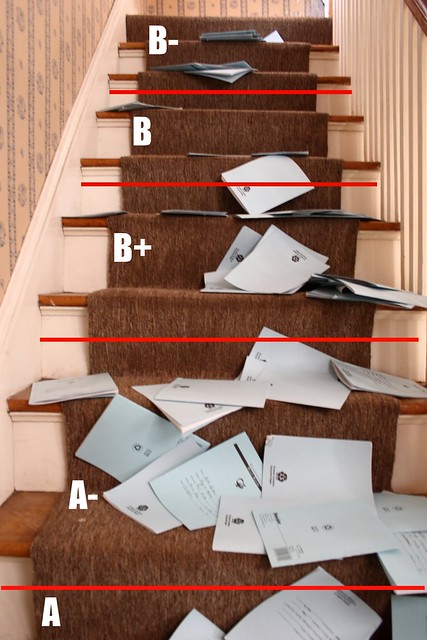
Some Thoughts on Grading

I'd say I hate letter grades, but that might be a little too strong. Maybe.

Photo courtesy ragesoss
CC BY-SA 2.0
For now I'll say I strongly dislike them, because it seems like no one really understands what grades mean.

I have a lot of thoughts about grading and assessment, actually. This might be the first post in a series because I have so many thoughts that I'm afraid it'll turn out to be something so long that no one will want to read it! Here are some of the questions I have been playing with for the past couple years, and continue to think about:
  • What are grades for?
  • How are grades generated?
  • What are the shortcomings of commonly used assessment practices?
  • What alternatives can we consider?
  • How then shall we assess our students?
This past semester in my Science Methods class, I went completely off the rails and ranted about my strong dislike of letter grades. It was in the context of a discussion of assessment in science, and how we might use standards-based assessment to enhance learning in science. (This is a topic I love, and my Master's thesis was on standards-based assessment in science.) I apologized to my students for speaking so forcefully on the topic--most weren't offended anyway, and a few even told me later that they loved seeing my passion coming out. While I appreciate their good-natured response, it did get me thinking about why I reacted so strongly. And I know what it is--when I was experimenting with standards-based grading in my science-teacher days, I got a lot of push back from a few colleagues who couldn't understand what I was doing. Because standards-based assessment is almost exactly but not entirely unlike more conventional assessment practices.

Not familiar with standards-based assessment? Here it is, in a nutshell: (copied and pasted from my old class policies website--this is how I explained it to the middle schoolers... "Big Ideas" = standards)

Thursday, January 3, 2013

Preparing Highly-Effective, Tech-Savvy Teachers

I had a meeting this morning with a couple of colleagues to talk about how we are using technology and how we are teaching our students to use technology. This is a big deal for me, and I've been thinking a lot about it over Christmas break.

Education Week shared this story earlier this week. It resonates with me very strongly; it gets at what Teacher Education Programs need to think about as we prepare pre-service teachers for the realities of technology in school. Because I'm guessing many beginning teachers--despite their digital native status--are simply unprepared to really teach with technology.

My friend Josh recently shared this infographic with me, and it sums up much of what my colleagues and I were discussing this morning. The big idea here is that there are clear habits of mind for how teachers who are effective at using technology in their teaching practice approach their craft.