Those of you who are regular readers may know how much I love geography. I think maps are cool. (I was that geeky kid studying the maps in the back of the social studies book in elementary school...)
I'm always on the lookout for fun geography sites, tools, lesson ideas, and repositories, and I keep stashing them away when I come across them. In case you are interested, a few previous posts of geographic resources...
Eight Helpful Resources for Teaching Geography
Seven More Helpful Resources for Teaching Geography
And Six More Helpful Resources for Teaching Geography
Of course, it seems like there always another new one that crops up. So, in no particular order, here's my latest batch...
Friday, February 19, 2016

Tuesday, February 16, 2016
Growing Dendrites
I had never heard of the book before today, but in an email hawking textbooks, I saw one title that caught my eye: Worksheets Don't Grow Dendrites by Marcia Tate. I cannot vouch for the book at all; I have not read it, and I don't know the author.
But this title rings true for me.
Dendrites, in case you haven't studied human anatomy and physiology lately, are the branches extending from neurons (nerve cells.) Every thought that you have is the result of electrical impulses traveling from one neuron to another, and it is the dendrites that allow for all sorts of communication to happen throughout the body as they connect the neurons. Each neuron can have thousands of connections to other neurons, and all of those dendrites matter for thinking and moving the body.
Why bring it up? Best we can tell, learning happens as the result of new connections between neurons. The saying (attributed to neuroscientist Donald Hebb) goes, "Neurons that fire together, wire together." And the idea here is that learning is the result of growing new neural connections, new dendrites connecting, "wiring" with other neurons. (Yes, yes, I know I'm simplifying the science here. If you'd like to learn more, you can read this page about axons, dendrites, synapses, and neurotransmitters.)
But this title rings true for me.
Dendrites, in case you haven't studied human anatomy and physiology lately, are the branches extending from neurons (nerve cells.) Every thought that you have is the result of electrical impulses traveling from one neuron to another, and it is the dendrites that allow for all sorts of communication to happen throughout the body as they connect the neurons. Each neuron can have thousands of connections to other neurons, and all of those dendrites matter for thinking and moving the body.
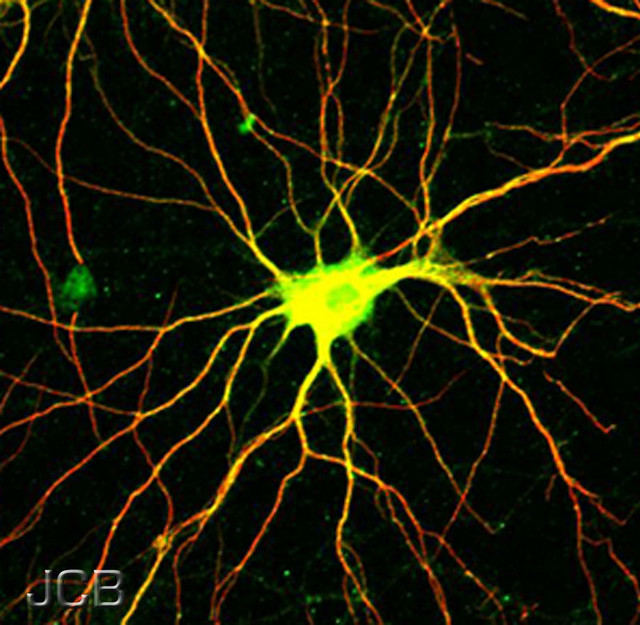 |
| Image by The Journal of Cell Biology [CC BY-NC-SA 2.0] |
Saturday, February 13, 2016
Getting Started with Education Design Research
This semester I am taking Education Design Research (EDR) as a research elective for my doctoral work. While I had heard of EDR before as a methodology, I really had never learned too much about it, so this course is is a great opportunity to learn more. EDR is also known as design-based research (DBR). This terminology may be more familiar for some, as it is sometimes used in other fields beyond education. I am fascinated by this approach so far, and I am interested in learning more!
The text we are using for this course is by McKinney and Reeves (2012), and I found their definition for EDR helpful; they describe this methodology as “a genre of research in which the iterative development of solutions to practical and complex educational problems also provides the context for empirical investigation, which yields theoretical understanding that can inform the work of others” (p. 7). The basic idea of EDR, then, is to develop an intervention to address a particular problem in education, while at the same time also generating theoretical understanding of the situation. Both quantitative and qualitative research methods can be used, depending on the nature of the research question, and from the reading I have done so far, EDR seems to be one way to make mixed-methods research a reality. (There is some contention about the used of both quantitative and qualitative methods in the same study in education; I can not speak to weather this is the case in all disciplines.)
Taking this as an introduction for the uninitiated into the idea of EDR, I feel that I should say that am not fully certain about just what this approach looks like in practice. I have looked at several examples of EDR studies, and it seems like there is a wide variety among them. So…a few parts are still a bit muddy for me.
The text we are using for this course is by McKinney and Reeves (2012), and I found their definition for EDR helpful; they describe this methodology as “a genre of research in which the iterative development of solutions to practical and complex educational problems also provides the context for empirical investigation, which yields theoretical understanding that can inform the work of others” (p. 7). The basic idea of EDR, then, is to develop an intervention to address a particular problem in education, while at the same time also generating theoretical understanding of the situation. Both quantitative and qualitative research methods can be used, depending on the nature of the research question, and from the reading I have done so far, EDR seems to be one way to make mixed-methods research a reality. (There is some contention about the used of both quantitative and qualitative methods in the same study in education; I can not speak to weather this is the case in all disciplines.)
Taking this as an introduction for the uninitiated into the idea of EDR, I feel that I should say that am not fully certain about just what this approach looks like in practice. I have looked at several examples of EDR studies, and it seems like there is a wide variety among them. So…a few parts are still a bit muddy for me.
Saturday, February 6, 2016
More Homework ≠ More Learning
It's been a while since I've blogged, and it's because I've been working on my comprehensive exams for the past few weeks. I ended up doing a sort of Twitter-fast in the process, because I just did not have the time to devote to those connections and conversations, though I love them so much and find them so valuable for stirring my thinking.
Today, I decided to take a break from other homework and just scroll through my TweetDeck for a few minutes. It felt good to be back, like having a cup of coffee with a dear friend and catching up. (There is probably some commentary about my love of technology there...)
And...wouldn't you know it...? One of the very first tweets I saw was a retweet from my Twitterfriend, Erin Olson (whom you should be following, if you are a teacher)...
The piece that was linked in her retweet here was intriguing to me, since I have an ongoing axe to grind about crappy homework. Here was the tweet:
Friends, if you are convinced that homework is a good thing for kids, you really have to read this.
Here, I'll make it easy...just click this link: "Homework in primary school has an effect of zero."
Okay, I'll make it even easier...here are a few quotes from the piece. Just read these:
Let's get this right, my fellow educators: more homework does not mean more learning!
Today, I decided to take a break from other homework and just scroll through my TweetDeck for a few minutes. It felt good to be back, like having a cup of coffee with a dear friend and catching up. (There is probably some commentary about my love of technology there...)
And...wouldn't you know it...? One of the very first tweets I saw was a retweet from my Twitterfriend, Erin Olson (whom you should be following, if you are a teacher)...
— Erin Olson (@eolsonteacher) February 6, 2016
The piece that was linked in her retweet here was intriguing to me, since I have an ongoing axe to grind about crappy homework. Here was the tweet:
"Homework in primary school has an effect of zero" (J. Hattie) https://t.co/PgWVPfaiL7 <- good read/interview #MTedchat— Jon Fines (@JonFines) February 6, 2016
Friends, if you are convinced that homework is a good thing for kids, you really have to read this.
Here, I'll make it easy...just click this link: "Homework in primary school has an effect of zero."
Okay, I'll make it even easier...here are a few quotes from the piece. Just read these:
"Homework in primary school has an effect of around zero. In high school it’s larger. (…) Which is why we need to get it right."
"It’s one of those lower hanging fruit that we should be looking in our primary schools to say, 'Is it really making a difference?'"
"Certainly I think we get over obsessed with homework."
"Five to ten minutes has the same effect of one hour to two hours."
"The worst thing you can do with homework is give kids projects. The best thing you can do is to reinforce something you’ve already learnt."These quotes come from an interview with John Hattie, an education researcher who has investigated over 130 influences on education and ranked them in order of the effect they have on student achievement (i.e., measurements of actual learning.) I've mentioned Hattie's list in an earlier blog post, where I noted that homework does make the list; it comes in at 88th place in terms of the effect it has on learning. There are so many other things we could (should?) be doing to improve student learning...why are we still assigning so much homework?
Let's get this right, my fellow educators: more homework does not mean more learning!
 |
| Image by David Mulder [CC BY-SA 2.0] |
Thursday, January 28, 2016
Comprehensive Exams
I have not posted much lately because I have been working on preparing for my comprehensive exams, and then writing my exams.
This has been so, so challenging for me. I know, of course...it's supposed to be challenging. And truthfully, I am feeling quite well-prepared for this. It's just trying to write while working around all the other parts of my life...sometimes it has me feeling like...

Those of you who know me well might be able to see this. Those who don't perhaps know me as well might be surprised. (Actually, I'm all dark and twisty on the inside...)
Honestly, things are going pretty well for the actual writing, but I there are times that I sort of hit a wall, so I start reading more to get on top of things, or hopefully break through.
The problem with that is, sometimes I find a new article or chapter to read, and all of a sudden, I'm like...

I'm not writing this for any sympathy or words of affirmation or anything like that. I know that I chose this, and the stress is temporary, if even of my own doing. (As my friend, Tom, reminds me, "I'm not busy...my life is rich and full!")
But if you could give my wife and kids a little extra encouragement, I think that would be welcome. They have been amazing, actually, throughout this process, and I'm so grateful for them.
Thanks for reading all. You guys are the best.

This has been so, so challenging for me. I know, of course...it's supposed to be challenging. And truthfully, I am feeling quite well-prepared for this. It's just trying to write while working around all the other parts of my life...sometimes it has me feeling like...
Those of you who know me well might be able to see this. Those who don't perhaps know me as well might be surprised. (Actually, I'm all dark and twisty on the inside...)
Honestly, things are going pretty well for the actual writing, but I there are times that I sort of hit a wall, so I start reading more to get on top of things, or hopefully break through.
The problem with that is, sometimes I find a new article or chapter to read, and all of a sudden, I'm like...
I'm not writing this for any sympathy or words of affirmation or anything like that. I know that I chose this, and the stress is temporary, if even of my own doing. (As my friend, Tom, reminds me, "I'm not busy...my life is rich and full!")
But if you could give my wife and kids a little extra encouragement, I think that would be welcome. They have been amazing, actually, throughout this process, and I'm so grateful for them.
Thanks for reading all. You guys are the best.
Thursday, January 14, 2016
Do You Have the Guts to Ask?
 |
| Image by Alan Levine [CC BY 2.0] |
After my last post, I tweeted a series of questions, challenging teachers (I suppose) to try asking their students for feedback about their teaching. Here's one:
What do you think you would hear if you surveyed your students about your teaching? #edchat #elemchat #mschat— Dave Mulder (@d_mulder) January 14, 2016
Tuesday, January 12, 2016
Satisfaction in Learning
My friend, Erik Ellefsen, recently tweeted this one to me:
Interesting thought, isn't it?
To what degree should we be concerned with student satisfaction? As an instructor in higher education, I am acutely aware of my end-of-term evaluations, and sites like Rate My Professors (I don't look at my reviews there...yikes...) that allow students to sit in the evaluator's seat and give the instructor a "grade." It's a tricky dance; it certainly feels good to have students give you accolades about your teaching...but does that mean catering to what they want, to their whims? Or does that mean challenging them with what they need...even if they don't necessarily want it? What is the mark of satisfaction in learning?
— Erik Ellefsen (@epellefsen) January 10, 2016
Interesting thought, isn't it?
To what degree should we be concerned with student satisfaction? As an instructor in higher education, I am acutely aware of my end-of-term evaluations, and sites like Rate My Professors (I don't look at my reviews there...yikes...) that allow students to sit in the evaluator's seat and give the instructor a "grade." It's a tricky dance; it certainly feels good to have students give you accolades about your teaching...but does that mean catering to what they want, to their whims? Or does that mean challenging them with what they need...even if they don't necessarily want it? What is the mark of satisfaction in learning?
Subscribe to:
Posts (Atom)