Showing posts with label 1-to-1. Show all posts

Sunday, October 19, 2014

We can't just hand them computers...they might learn something!

I confess it...I went through a kick sometime in the past year or so where I made a bunch of snarky graphics at someecards. In the batch someplace was this one:

I had used it to illustrate my point for a blog post about the way so many 1:1 programs are structured--very similar to what Cuban (2013) argues--as if the use of educational technology is some kind of magic bullet that will suddenly cause amazing learning to happen.
Actually, as I reflect on this, I think the silly graphic here isn't telling the truth. I think we can expect that kids will learn things if we hand them a laptop connected to the Internet. The problem is, in formal educational settings, we generally want to control just what it is that they learn, and ensure that it is focused on some broader educational goals or standards or scope & sequence of prescribed learning outcomes.
And this seems to be just the opposite of what Mitra is arguing for. Mitra et al. (2005) emphasize this in their very hypothesis: "if given appropriate access and connectivity, groups of children can learn to operate and use computers with none or minimal intervention from adults" (p. 2). For me, the question remains "Is this good enough?"

Thursday, April 4, 2013

Teaching Through Technology

I spent the day today at the Iowa 1:1 Conference. Interesting to meet up with several hundred (maybe a thousand?) educators thinking about teaching through technology. I have a lot of thoughts rolling around in my head right now...especially about how a 1:1 program would work in Higher Ed.

One of my biggest questions is about how to teach the teachers for the realities of teaching through technology.

There's a great model for talking about teaching through technology--it gets at how teachers can and should think about this. It's abbreviated TPACK--which stands for Technology, Pedagogy, and Content Knowledge. As a teacher educator, I've been thinking a lot about the intersection of pedagogy (how to teach) and content knowledge (what to teach). And as a technophile and former Technology Coordinator, I've also thought a lot about technology in education. But this model looks at the coordination of all three of these. I'm thinking about this because I'm going to be teaching a masters-level course in Teaching and Learning with Technology this summer, and I'd like to use the TPACK model as a part of the class.

Tuesday, January 15, 2013

A Student's Perspective on a 1:1 Program

I've been writing on the blog a bit lately and tweeting about my thinking on 1:1 programs, and one of my former students took notice. She is currently in a school in the midst of implementing such a program, and she wanted to give me "the student's side of the story." I told her I'd try to keep her anonymity in tact, but I did ask her permission to share her story, because I find it so interesting.

Here is what she shared:

Friday, December 28, 2012

Apps for Education in Higher Ed: 1:1 Goes to College

I'm thinking a lot lately about a 1:1 environment in higher ed. I'm going to be teaching in a high tech classroom this spring, and I'm working on rethinking my pedagogy accordingly. I'm debating about whether I should expect my students to come to class with a device every time we meet. At this point, I don't think I'll require it (it won't say so in the syllabus, anyway), but I'm curious to see how many will start to bring a laptop or tablet along anyway on a regular basis.

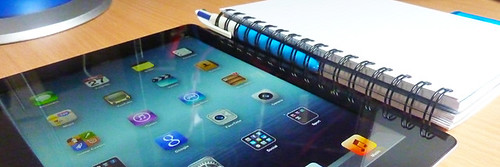
Photo courtesy Sean MacEntee (CC BY 2.0)
At any rate, I think the day is coming--and probably soon--when a tablet will be as commonplace in higher ed classrooms as they are becoming in elementary classrooms. MacFan that I am, I'm thinking especially about iPads right now. I'm wondering about the mindshift that will have to happen for professors to embrace tablets as a pedagogical tool? Because I'm convinced that tech tools should be able to transform teaching, and not just replace old assignments with newer, shinier versions of the old.