Showing posts with label Teaching Strategies. Show all posts

Thursday, September 3, 2020

Embracing Many Approaches to Distance Teaching

I received an email yesterday afternoon with the subject, "Teach online correctly—from the very start." I confess, I was intrigued. I clicked to open, and this is what I saw:


It was an ad for an online course being offered by an organization I follow. I get their newsletter, and that's why I'm on their mailing list for this ad, I suppose. But this fascinated me, because the implied message here is "there is a right way to teach online, and a wrong way to teach online, and you don't want to do it wrong, do you???"

I wonder about this. Would the folks putting on this course suggest that there is one right way to teach a face-to-face course? Or would they take a more nuanced view, that teaching well depends on the needs of the students, the needs of the content, the conventions of the discipline, the affordances and constraints of the classroom, and the preferences of the instructor? Because I suspect teaching math looks different than teaching music--the content alone makes these very different endeavors, regardless of the medium of instruction and the classroom environment!

I view teaching as a craft, rather than a pure art or pure science. Yes, there are some universally valuable pedagogical approaches. And, yes, there are many different ways to conduct our work--different style preferences that we might have as instructors. I don't see this as an either-or proposition. Both of these can be true at the same time. And...I would dare to venture that this is still true in the online learning environment, just as it is in the face-to-face learning environment.

Somehow it seems that some people see "online teaching" as a monolith, that there is just one way to do it. But, seriously...let's think that through. Is there just one way to teach in a face-to-face classroom? Obviously not. Some folks lecture. Some facilitate discussions. Some incorporate hands-on, experiential learning opportunities. Some use inductive, "solve the mystery" approaches. Some use collaborative learning. Some incorporate reflective thinking. Some use combinations of these--and lots of other approaches--in just one lesson! 

And the same is true of distance teaching: there are lots of possible approaches that can be used, just like in the face-to-face classroom. Some folks lecture (via video.) Some facilitate discussions (in asynchronous discussions forums.) Some incorporate hands-on, experiential learning activities (by getting students away from their devices to do something, and then share about what they discovered.) Some use inductive, "solve the mystery" approaches (like digital breakout rooms, or mystery boxes.) Some use collaborative learning (because there are all kinds of tools that can be leveraged for online collaboration these days!) Some use reflective thinking (by writing blog posts, or papers, or student-created videos to make meaning of their learning.) Some use combinations of these--and lots of other approaches--in just one (online) lesson!

Come on...just one "correct" way to teach online? I suppose the one "correct" way to teach online is to match your teaching methods to the learning target, to keep in mind your student' needs, the needs of the content, the conventions of the discipline, the affordances and constraints of the online learning environment, and your preferences as an instructor.

Let's embrace many approaches to distance teaching!


---

(This post is part of a series offering tips on distance teaching. You can read more about this project here: Distance Teaching Tips. You can also read all of the posts in this series here: Distance Teaching Tips Series.)

Friday, November 15, 2019

The Evolution of an Undergraduate Research Project

Many of you regular readers will know that I am constantly playing with my teaching practice--experimenting, exploring, trying to improve things. Maybe this says something about my inner state; maybe this means I'm never quite satisfied that it's "good enough." Honestly, that's probably true. I'm a work in progress, and I hope that I'm continuing to get better all the time.

I've taught Introduction to Education 15 times over the past 8 years, and it's one of my favorite courses to teach. It's also the course I teach that literally anyone in my department could teach...but I love it, and I like to think I'm a good fit for it. For the most part, I feel like I've got this course dialed in to where I want it to be: it's a pretty tightly aligned course, with clear learning targets, reasonable assessments, and instructional activities designed to ensure students will come away from the course with a strong foundation for the rest of their learning in our Teacher Preparation Program.

But...it's not perfect. (Obviously, since I am not perfect!) And so, I continue tinkering with the course, tweaking it, trying to find ways to make it a more engaging learning experience for students, one that will help them discern whether becoming a teacher is their calling, and helping them develop a beginning level of the knowledge and skills they will need as professional educators, should they decide to continue in the program.

As long as I've taught the course, I've had a research project as a key assignment. I assign students to research an education reform initiative, and share what they learn with their classmates. The goals for the project are threefold:

Wednesday, September 12, 2018

How to Learn from a Textbook

I'm thinking today about textbooks.

Probably this is because today I gave my Middle School Curriculum & Instruction students an assignment to review curriculum materials. It might also be because I have a textbook that I love that I'm using for teaching World Regional Geography. Okay, and it might also be because I was helping one of my kids take reading notes on a textbook-based reading assignment tonight.

Textbooks are a really great resource for teachers. I remember feeling as an undergraduate Education major a sense of pressure that if I ever relied on a textbook I would somehow be failing my students. But I've definitely come around: textbooks can be an extremely helpful resource to support teaching.

Thursday, February 1, 2018

The Tentative Nature of Science

Yesterday in my methods of teaching science class, we took the whole class meeting to wrestle through the nature of science. By "nature of science," I mean trying to understand what makes science...science. How do scientists approach their work? What are the ground rules for doing science? What are the limits of science?

I love this shirt...and, yes...I've worn it to class... [CC BY-SA 2.0]

It's a fun challenge each time I teach this course to try and help the future teachers I serve shift their thinking. So many of them come into this course with strong, pre-conceived ideas about science as a discipline. I'm convinced that partly this is due to a broad cultural (mis)understanding of what science is and how it works...but I think part of it is something that we, teachers, have perpetuated.

Thursday, September 21, 2017

Learning to Teach Again: Leading Them to Water

As I continue to reflect on my experience teaching a brand new course, I have come to realize how much pressure I put on myself to be excellent.

This isn't entirely surprising to me. I have high expectations for myself as a teacher. I take my work very seriously--even though I don't take my self too seriously. I count it simultaneously a blessing and a burden to be tasked with ensuring that students learn. Yes, I use the word "ensure." This is dangerous, I know--can I really ensure that students will learn? It would be safer to say I "provide them with opportunities to learn," wouldn't it? But that's not how I see it.

One of my professors in my M.Ed. work (the inestimable John Van Dyk, who has had a profound and pervasive impact on the way I think about my role as a teacher) reminded us:


I take that seriously. Yes, my students have to do the hard work of learning. I can't make them drink. But...am I doing what I can to make them thirsty?

The trouble with this is that I start to put a bit of a burden on myself then, you see? I want to do my best to make class for my students; I want to structure the learning environment in such a way that it supports them, encourages them, challenges them, engages them, and--dare I say it?--makes them a little thirsty.

I'm working on it. I know that I'm not the most engaging lecturer. I think I'm better as a storyteller than a lecturer. The emotional engagement from a story gets them "thirsty" in a way that just the fact never will. But it's harder to tell stories the first time you're teaching a class. And there is so much content in this geography course! While I'm confident in my ability to teach it, it's my first time through. Planning a lecture--even though it might be more "boring" for the students--feels safer.

But...

Lecturing (for me) doesn't seem as effective at leading them to water. (It's not that lecture is "bad" as a methodology...but bad lecture is THE WORST.) So even though its a little scary for me, I'm trying to get students more actively involved. I'm asking them to help direct my class presentations by asking questions to clarify what they've read. This has been pretty successful so far, but it's definitely still a work in progress for me. I'm also trying to do in-class projects and collaborative work that gets them more actively involved than just sitting back and listening.

Today, for example, we were exploring intergovernmental organizations, like the UN, EU, NATO, NAFTA, G-8, SCO, BRIC, WTO, IMF, and more...it was alphabet soup! And rather than me lecturing my way through all of these organizations, I figured we could collaboratively generate a database.

So I made a Google Doc and populated it with a list of 20-ish supranational organizations, and shared it with my class. Basically we were seeking to answer three questions about each of them:
1. What is this?
2. Who are the major players?
3. Why should we care/be concerned about this?

The students partnered up and launched in, and after about 10 minutes, we had a solid beginning. I then directed them back to it to read through others' responses, adding to them, tweaking, modifying, updating...trying to get the best responses we could. I read through them too, and made a few tweaks myself, adding some info, correcting a few (very slight) errors. And there it was: a database of organizations, developed collaboratively and vetted corporately (and by me.) They were actively involved throughout, and the "why should we care?" question really worked for them--this was part of the running them around the waterhole, I think.

Can I ensure that they all will know about the African Union, and DR-CAFTA, and the Arab League, and OCED? Hard to say, I suppose. But were they actively involved in learning about them today in class, with a sense of "need to know?"

Yep.

I marked today's lesson as one of the most successful of the semester so far.

Friday, September 15, 2017

Learning to Teach Again: Getting Them to Read

I've really been thinking about reading this week. A big part of the prep work for college-level course work is reading. I assign a fair bit of reading to my students--generally at least a chapter to prepare for each class meeting. (This varies a bit, of course, depending on the subject matter or the course.) And I think it's pretty important for students to do this reading.

I mean, if it wasn't important, I wouldn't assign it, right?

But I'm also a little cynical. I know that as a college student, I didn't always do all of the reading assigned. (Gasp! This feels like true confessions...) I suspect that some of my students are in this boat too. It's not like they deliberately set out to not prepare for class. But I wonder sometimes if there are things I'm doing as an instructor that make it less likely that they will do the reading I want them to do?

Friday, July 21, 2017

Teaching and Ramen Noodles

Seeing the title of this post might make you think that it's about teachers' compensation packages. While that is definitely a topic we should discuss sometime, that's not the point of this post.

Instead, a story in contrasts, and a thought I had in response to it.

Earlier this summer, my wife and were vacationing in Hawaii. (Yes, it was fantastic.) We enjoyed every part of it, including the food. Near our hotel, there was an area where there were many food trucks parked, and we had lunch there a couple of times, trying different cuisines offered through the window of a mobile kitchen.

Here was my favorite:

When the signs on the truck are in both Japanese and English, it's a good omen.

Tuesday, February 16, 2016

Growing Dendrites

I had never heard of the book before today, but in an email hawking textbooks, I saw one title that caught my eye: Worksheets Don't Grow Dendrites by Marcia Tate. I cannot vouch for the book at all; I have not read it, and I don't know the author.

But this title rings true for me.

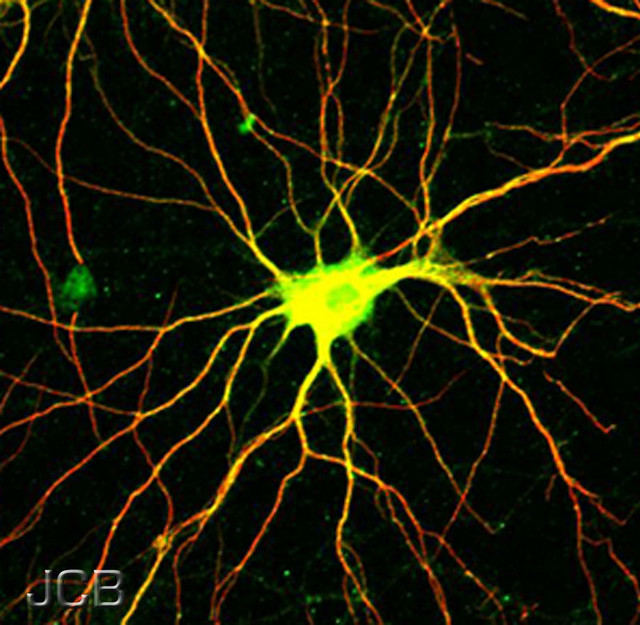
Dendrites, in case you haven't studied human anatomy and physiology lately, are the branches extending from neurons (nerve cells.) Every thought that you have is the result of electrical impulses traveling from one neuron to another, and it is the dendrites that allow for all sorts of communication to happen throughout the body as they connect the neurons. Each neuron can have thousands of connections to other neurons, and all of those dendrites matter for thinking and moving the body.

Image by The Journal of Cell Biology [CC BY-NC-SA 2.0]
Why bring it up? Best we can tell, learning happens as the result of new connections between neurons. The saying (attributed to neuroscientist Donald Hebb) goes, "Neurons that fire together, wire together." And the idea here is that learning is the result of growing new neural connections, new dendrites connecting, "wiring" with other neurons. (Yes, yes, I know I'm simplifying the science here. If you'd like to learn more, you can read this page about axons, dendrites, synapses, and neurotransmitters.)

Monday, September 7, 2015

Awe and Wonder: Space is BIG

In my science methods class today, we were talking about how to foster a sense of awe and wonder in students. I was sharing with my students how I hope science teachers help their students to have moments in which they simply stand amazed at the way this world has been shaped and created.

As an example, I shared with them this illustration of just how BIG the distances are in astronomy. I actually had all of the balls I describe here collected and ready for illustration. I hope this might foster a bit of awe and wonder for you too!

---

Space is BIG.

How big is it? Let’s make a model…

Image that the Earth is a super-ball about 1 inch across.


On that scale, how big is the moon? Bigger than Earth? Smaller than Earth?

Thursday, August 27, 2015

"Doing Science" with Fortune Fish

I love the variety of courses I get to teach for pre-service teachers. The one I've been teaching the longest is "Teaching Science PreK-Middle School." I began adjuncting this course in 2007, and it has slowly evolved over time to the current state, after 15 or so iterations.

One of the key themes that has not changed, however, is that I have my science methods students "do science" on a weekly basis. That is, we aren't just learning about science; we are actively investigating, observing, inferring, experimenting, and communicating what we discover. I want them to experience learning science this way in the hope that they will carry this approach to teaching science into their own classrooms down the road.

So, when we began the new semester in science methods yesterday, their first assignment is an investigation...

I handed out a little plastic sleeve to each student:

What's in the package?

Thursday, June 4, 2015

Dissenting Opinions

This tweet showed up in my Twitterfeed today, retweeted by a friend:


I laughed. So truthy. (Like something @BluntEducator might have tweeted.)

A similar idea actually came up in a pedagogy workshop I was part of yesterday. A group of colleagues from across disciplines get together regularly throughout the summer to talk about our teaching practices--it's a great way to get to know faculty from other departments and to reflect together on how we are teaching.

Tuesday, March 31, 2015

Teaching Science with Slime

I love all of the courses I teach, but I have a special affinity for my elementary and middle school science methods course, a course about how to teach science. You see, I was a middle school science teacher for 8 of the 14 years I spent in K-12 schools, so it feels like a big part of my identity. I love science, and I loved teaching science to middle schoolers, and I still love teaching future elementary teachers (who often seem to fear science a bit at the beginning of the semester) about this subject I love so much.

Wednesday, February 25, 2015

What's In Your Desk Drawer? Day 18

A stack of little papers...

Those of you who read my blog regularly know that I'm a technophile. I love gadgets, and I'm always interested in learning something new. I regularly experiment with new technologies in my teaching practice too, so I've tried a lot of techie things to find out what my students know and understand. I've used Edmodo, and Socrative, and PollEverywhere, and Padlet, and others, I'm sure. And I've had success with each of these, actually. They do different things, and they have different strengths and weaknesses, so I use them in different ways. But all of them are good for what we call "formative assessment." (Just a little education jargon for your day...)

Tuesday, September 9, 2014

My Adventure in Flipping the Classroom: Middle School Curriculum and Instruction

I'm teaching a course this semester in middle school curriculum and instruction. While I can't choose one course as my "favorite" to teach (that's like choosing between your kids!), I do LOVE to teach this course!

I'm using the flipped classroom model for teaching it, which has been a great learning adventure for me. This means I record lectures for them to view outside of class (along with other readings and preparation work,) and then when we meet together in class we apply the ideas to real situations.

A screengrab from an online lecture I was recording.
Just check out the passion...or craziness...in those eyes...

Friday, August 1, 2014

Thoughts about Meaningful Interactions in Online Courses

As regular readers of this blog will likely know, I am currently part of a doctoral program in Educational Technology, and my learning in this program is online.

The online design of the program is deliberate. It is convenient for me to be able to study at a distance, to be sure, but I'm also learning--both through the content of my coursework as well as the pedagogies employed--how educational technologies offer alternatives to face-to-face learning environments.

Early in my program, we spent a significant portion of a course reading about, discussing, and reflecting on the No Significant Difference phenomenon: the fact that countless research studies have shown that there is no statistically significant difference in learning outcomes when the media of instruction is varied. The body of research reviewed is comprehensive and compelling; it goes back to the 1920's, and includes correspondence courses, video-based instruction, and--more recently--online courses. The results indicate that while the experience of the course may be different, the learning is "not significantly different."

I confess though, I still get hung up on this point. Because the learning experience is not identical.

Saturday, July 19, 2014

10 Ways to Use Social Networks as a Teaching Tool

In my last post, I shared a story as an example of how I learn from my PLN. I use Twitter as a key part of my PLN--I'm there to interact with other educators, to share ideas and resources, and to learn. Twitter (and other social networks) seem like a perfect fit for learning, but perhaps best for informal, personalized, just-in-time learning. This has me thinking and wondering about how well social media fits as a teaching tool. Can social networks be used for formal, whole-group, structured learning as well?

Image via Garrett Heath [CC BY 2.0]

Tuesday, July 8, 2014

Getting Beyond Low-Level Tasks

Let's be honest: much of what passes for learning in many schools today is relatively low-level tasks that don't require too much on the part of students.

Curriculum developers don't help this situation, and tend to try and pre-package easily-digestible bits for the students.

Teachers (pointing the finger at myself here, at least early in my teaching career) are all too willing to follow the canned teacher's manual or pacing guide to move students through the steps.

We must provide them with practice to ensure that they remember the key facts and ideas! Worksheets galore!

How will we know if they have learned it? If they can appropriately regurgitate cut-and-dried responses to questions on tests, they must have learned it, right?

You may be getting a sense of my cynicism about this kind of teaching. My fear is that this approach continues to minimize the role of the teacher to a mere technician: get the kids to jump through the right hoops, press the right buttons, fill in the right bubbles on the sheet, and you've done your job, right teacher?

Let's commit to moving beyond just going through the motions to actually engage our students. Real learning is messy, complex, and multi-faceted. Let's ask our students to do work that gets beyond simple low-level tasks.

How shall we do this?

Monday, June 30, 2014

Guerrilla Teaching

I regularly participate in #iaedchat (Iowa education chat) on Sunday evenings (8 p.m. Central Time.) We discuss a wide range of topics, and it isn't just Iowa educators in the chat. If you teach and are on Twitter, I highly recommend it.

In our last Twitterchat we were discussing the value of peer visits to your classroom. We discussed the differences between administrator visits and peer visits, the nature of the feedback teachers can get from peers, and how to translate this feedback into action. The ideas were flying fast--lots of interesting approaches and great techniques!

I suddenly had the image of "guerrilla teaching"--instead of a structured visit, bursting in on a colleague's class (invited, of course) and joining in the teaching under way. I shared this idea to some enthusiastic response.

No, not this kind of guerrilla teaching! [Image from quimbob]

Thursday, April 10, 2014

The 60% Rule

(Note: I wrote this post for CACEPlease visit to view the original piece and check out the other great stuff there! You can also follow them on Facebook and Twitter...and you should, if you're at all interested in Christian Education.)


Do you have a favorite teaching strategy? What is your best approach in the classroom?

Do you lecture with passion? Do you involve your students in collaborative groups? Do you have students complete stacks of worksheets? Do you use project-based learning? Do you have students craft personal, creative responses to demonstrate what they have learned? Do you use digital simulations? Do you show videos? Do you play games? Do you tell stories that capture students’ imagination and pull at their hearts? Do you have students role-play or use drama? Do you have students investigate solutions to authentic problems? Do you have students actively serve in their communities?

The methodologies we choose clearly show what we value. You might say that the teaching strategies you choose flow out of your personal philosophy of education. What you believe to be true and important and necessary are the things you will emphasize.

Parker Palmer, in his excellent book The Courage to Teach: Exploring the Inner Landscape of a Teacher’s Life makes the claim, “We teach who we are.” Think on that. Who you are as a human being is embodied in your teaching practice!

Early in the book, Palmer states, “Teaching, like any truly human activity, emerges from one’s inwardness, for better or worse. As I teach, I project the condition of my soul onto my students, my subject, and our way of being together” (p. 2). As I reflect on this, I think it’s important to think about the methodologies I choose for my teaching…and what these say about me…


Tuesday, March 18, 2014

Maybe We Should Ban Worksheets

I've been thinking a lot about homework and the way we have students work in school. I've been thinking about worksheets in particular lately. It's not that I've never assigned a worksheet; I have.

But I'm wondering whether it's time to reconsider what worksheets are for, and why teachers use them instead of other learning strategies?

---

I took the time to participate in #satchatwc (Saturday Education Chat, West Coast Edition) on Twitter this past Saturday morning. Great chat--wide ranging group who attends, but a little overwhelming because of the sheer number of participants.

This week our topic was student engagement, feedback, and data-informed instruction. (That's a lot for a one hour chat!) This chat uses a question and answer format, so the moderators tweet questions (Q1, Q2, etc.) and we share our answers in response (A1, A2,...)  Our responses to the questions often spark side conversations in which we interact more with the ideas our fellow-chatters share.

About 45 minutes in to the chat, the 6th question was raised: "How can we make learning 'visible' to parents?"

Love that question! There are many ways to share stories from school at home.

As we discussed this question, some folks began talking about sending work home. And since I've been thinking about homework a lot lately, and worksheets in particular, I tweeted this: