So I saw a tweet yesterday that included the following graphic from my long-time Twitterfriend, Paul Munshower.
My first reaction was to laugh, and I did chuckle.
But, almost immediately, I stopped and checked that reaction. Oh, not because this is untrue...it probably is a really accurate way of framing that feeling. (And, yes...as a professional educator, I have had that feeling checking my balance with my bank...which is a comment on the state of compensation for teachers...but not the real point of this post.)
The main reason I checked myself is the idea that this comment conveys: that grades are like money in the bank, deposits from your earnings.
Now I know there are plenty of people who would equate grades as "earnings," as in, "Students earn their grades."
But I do wonder a bit about this metaphor. Are we really comfortable with thinking about grades as compensation? I'm not loving this idea, honestly. I know, I know...we use this language all the time. But what is a grade, really? Is it payment for the work students do? Or...is it meant to be communication about their learning?
I suppose if you're viewing grades as pay for the work students do, there isn't any problem here. Students put in their time, do what they are asked to do, and get their paycheck. Worked hard? You get an A! Not working quite as hard? B+ for you, kiddo. Just coasting and not really doing the work? D- for you. And I guess the idea here is that compensation matches the effort; kids who are really working hard are going to get better "pay," while the kids who are coasting are going to get worse "pay." That's how the "real world" works, after all, right? People who work hard get raises, and lazy people never get ahead...and might even lose their jobs, yeah? Grades viewed this way are really an economic proposition.
But here's what makes me uncomfortable with this: I don't think grades are actually pay. Grades should be communication about what kids have learned, ideally. I don't think they are actually all that great for this purpose, because you lose all the nuance by trying to collapse a whole term's learning into one letter or number. Regardless...if we start trying to turn this communication into payment...are we really communicating learning anymore?
And I don't think that kids who just "work hard" are going to get high marks while lazy students are going to get low scores. I'm not arguing against developing a work ethic; I think everyone agrees that we want kids to learn how to work. But I'm standing here in opposition to the idea that kids who work hard deserve good grades just because they have worked hard. I mean, you can "work really hard" at doing the wrong thing and not end up making any progress. If we're basing kids' grades on whether or not they worked hard, what are we actually assessing? Their work habits? Or their learning?
Grading is not--or at least should not--be an economic transaction. The teacher is not the boss on the jobsite doling out dollars for the day's work to the laborers. If we're serious about grades actually reporting learning, we have to work to purge our vocabulary of this language about "earning."
Showing posts with label Grading. Show all posts
Sunday, November 3, 2019
Friday, September 20, 2019
Grading and Feedback
Yesterday, I received an email from one of my amazing and thoughtful students. She is currently in a field experience placement where she is practicing the "real work" of teaching, including providing feedback to her students. The subject of her email was "Grading and Feedback," and I'm sharing it here with her permission (edited slightly for confidentiality):
First off, how great is this? A pre-service teacher who is in transition to the work of a professional teacher, and she is beginning to realize the challenging nature of our work as educators. But rather than just foundering, she is soliciting input! I'm honored that she reached out to me--not that I have this all figured out, of course--but the key thing I'm thinking about here is the importance of mentorship and support for novice professional teachers.
Here is what I shared with her in response:
Hello Dr. Mulder,
I have been doing my field experience practicum in a sixth grade class and have been learning so much. One thing that I have been recently faced with is grading and giving feedback and you came to mind. I gave the students a summary exercise in which they had to write a summary paragraph. I am now reviewing these and am realizing my inexperience with grading REAL kids’ work!
I don’t want to kill their joy for learning, but I also want to give the valuable feedback that will help them grow. How do you strike this balance (especially in middle school)?
Thank you for your time in considering this.
First off, how great is this? A pre-service teacher who is in transition to the work of a professional teacher, and she is beginning to realize the challenging nature of our work as educators. But rather than just foundering, she is soliciting input! I'm honored that she reached out to me--not that I have this all figured out, of course--but the key thing I'm thinking about here is the importance of mentorship and support for novice professional teachers.
Here is what I shared with her in response:
Tuesday, November 24, 2015
The Problem with Grade Books
Grade books are a real problem, and I don't think enough teachers are actually thinking about how they use their grade books.
A grade book is intended to help keep track of student learning. But I wonder sometimes about this. The very design of a grade book is--whether digital or analog--to record symbols intended to represent a certain quantity of learning. Every piece of evidence a particular assessment vehicle provides has to be evaluated--measured, quantified, and scored--in order to be recorded in a grade book. Grade books are generally not designed to capture rich, holistic information. They are designed to capture tiny bits of information distilled and consolidated into symbols--points, scores, percentages, letters--that are easy to record in the tiny boxes that make up the grade book.
And...there's the problem, I think. The technology of a grade book dictates how we use it. (And make no mistake, it's a technology, whether it's in digital or analog format. Curious about that idea? Here's another post that might help you understand my thinking on this concept of non-digital tools being technologies.) As the quote attributed to Marshal McLuhan puts it: "We shape our tools and afterwards our tools shape us."
A grade book is intended to help keep track of student learning. But I wonder sometimes about this. The very design of a grade book is--whether digital or analog--to record symbols intended to represent a certain quantity of learning. Every piece of evidence a particular assessment vehicle provides has to be evaluated--measured, quantified, and scored--in order to be recorded in a grade book. Grade books are generally not designed to capture rich, holistic information. They are designed to capture tiny bits of information distilled and consolidated into symbols--points, scores, percentages, letters--that are easy to record in the tiny boxes that make up the grade book.
| This is a photo of one of my first grade books. Look at all those "10's!" |
And...there's the problem, I think. The technology of a grade book dictates how we use it. (And make no mistake, it's a technology, whether it's in digital or analog format. Curious about that idea? Here's another post that might help you understand my thinking on this concept of non-digital tools being technologies.) As the quote attributed to Marshal McLuhan puts it: "We shape our tools and afterwards our tools shape us."
Saturday, October 17, 2015
What is Really Important?
A dear friend who is a social worker shared this via Facebook this morning...
This is a real concern.
Really.
Kids struggle with depression.
Let me say that again:
Kids. Struggle. With. Depression.
This is a real thing, and if you a teacher, a parent, or work with young people in any way, you need to be aware of this.
![]() |
| From the Iowa Foster & Adoptive Parents Association's Facebook page. |
Really.
Kids struggle with depression.
Let me say that again:
Kids. Struggle. With. Depression.
This is a real thing, and if you a teacher, a parent, or work with young people in any way, you need to be aware of this.
Friday, October 9, 2015
Grades Should Report LEARNING
I think you may need to know where I'm coming from if you're going to read this post, so you don't think I'm just suddenly ranting out of thin air.
Early in my teaching career, I was all about the points. I've written before about my "bucket-o-points" approach to grading, and how I slowly shifted away from this perspective. (I encourage you to read the article linked above for that story.) But this is still a passion area for me, and I think most teachers aren't nearly mindful enough about our assessment practices, and more specifically, about our grading practices.
Okay, on with the post...
---
I was recently doing some reading in preparation for a lesson I'm teaching next week, and I am using John D. Mays's lovely little book Teaching Science so that Students Learn Science as a text for the course. While Mays is giving advice to science teachers in particular, much of what he has to say applies to teachers in general.
Take this gem, for instance:
Thursday, November 21, 2013
The Moral Imperative of Assessment
I think this will be my last post from #AMLE2013, but you never know.
Rick Wormeli said something about assessment in the closing session I attended that has taken hold of me and keeps nagging at the back of my mind:
If you know that the child knows something, but the assessment vehicle you've chosen doesn't show it, you have a moral obligation to change it.
The phrase "moral obligation" has me. I totally agree. It's tantamount to malpractice as a teacher if you are sure a student has learned something and the assessment vehicle (test, quiz, project, essay, interview, debate, what-have-you) doesn't show their understanding of the content. We must change our assessment practices.
And of course, the question offered in response is, "How do I know that they know it, if they can't do X?"
C'mon, teacher.
If the first chance students have to show you what they know, understand, or are able to do is the final, summative judgment...you're doing it wrong.
Get to know your students.
Be actively involved in their learning.
Assess along the way.
Give descriptive feedback.
Stop grading for compliance--or the lack thereof.
Assess what you most highly value, not what is most easily measured!
To do any less is a moral failure for your students.
And then you deserve the "F," not the kid.
Friday, November 15, 2013
We Are Really Bad at Grading
Teachers, you really should watch this short spot advertising a Canadian sit-com about a bad teacher. There are two truths I want to draw out of this.
Pretty funny, right? And perhaps a little too uncomfortably true?
Here are the two truths:
Pretty funny, right? And perhaps a little too uncomfortably true?
Here are the two truths:
Friday, April 19, 2013
The Problem with Averaging Grades
It is common practice for teachers to calculate grades for their students by "averaging." That is, teachers add up the points students have been assigned for their work, and divide by the number of points possible. Mathematically, that's what "averaging" is--computing the mean for a data set.For example, imagine that a student received the following marks on assignments throughout the term:
92, 84, 87, 60, 88, 89
Calculating the mean (average) would entail adding up these numbers:
92 + 84 + 87 + 60 + 88 + 89 = 500
Thursday, April 18, 2013
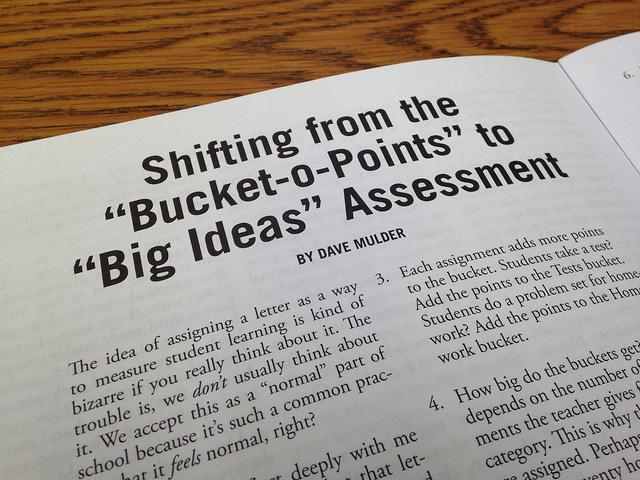
The Bucket-O-Points Approach to Grading
This year marks my 15th as an educator. Some things about my teaching practice have changed dramatically over that time; I'm the sort who continues to tinker and experiment with my classroom practice, because I'm sure I can get better. My thinking about the meaning and purpose of assessment has definitely shifted over these years. I've been thinking a lot about assessment lately, and I've been having conversations with colleagues about assessment for several years now. It boils down to the fact that I'm concerned with how letter grades are used.
When I started teaching, I was a junior high math and high school computer applications teacher. Being a "math guy," I was all about intricate calculations and statistical analysis of my students' grades. I had programmed a spreadsheet to do my calculations, weighting different categories, and even color coding so I would know at a glance what grades students were getting. ("A" = Green, "B" = Yellow, "C" = Orange, "D" or "F" = Red)
Looking back now, I call my approach then the "Bucket-O-Points" approach to grading.
When I started teaching, I was a junior high math and high school computer applications teacher. Being a "math guy," I was all about intricate calculations and statistical analysis of my students' grades. I had programmed a spreadsheet to do my calculations, weighting different categories, and even color coding so I would know at a glance what grades students were getting. ("A" = Green, "B" = Yellow, "C" = Orange, "D" or "F" = Red)
Looking back now, I call my approach then the "Bucket-O-Points" approach to grading.
Wednesday, April 17, 2013
Oh, Letter Grades...What Shall We Do With You?
The idea of assigning a letter as a means of measuring a student's learning is really kind of crazy if you think about it.The trouble is, we don't usually think about it. We accept this as a "normal" part of school...because it's such a common practice, it feels normal, right?
But think for a moment about what that letter really represents. Think about report card grades: condensing a whole term's worth of learning into one symbol. Doesn't that strike you as a pretty outrageous reduction?
Saturday, January 5, 2013
Some Thoughts on Grading
I'd say I hate letter grades, but that might be a little too strong. Maybe.
For now I'll say I strongly dislike them, because it seems like no one really understands what grades mean.
I have a lot of thoughts about grading and assessment, actually. This might be the first post in a series because I have so many thoughts that I'm afraid it'll turn out to be something so long that no one will want to read it! Here are some of the questions I have been playing with for the past couple years, and continue to think about:
Not familiar with standards-based assessment? Here it is, in a nutshell: (copied and pasted from my old class policies website--this is how I explained it to the middle schoolers... "Big Ideas" = standards)
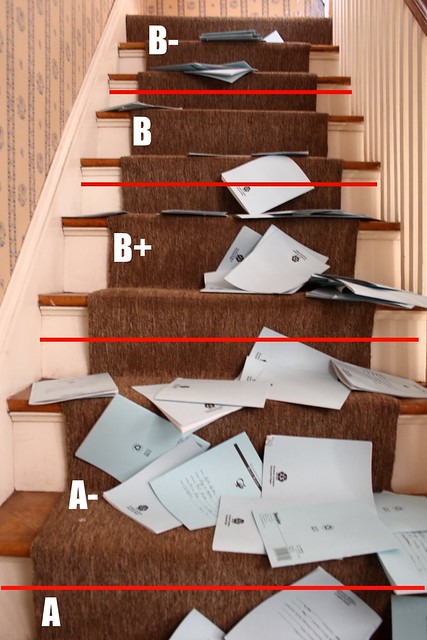
| Photo courtesy ragesoss CC BY-SA 2.0 |
I have a lot of thoughts about grading and assessment, actually. This might be the first post in a series because I have so many thoughts that I'm afraid it'll turn out to be something so long that no one will want to read it! Here are some of the questions I have been playing with for the past couple years, and continue to think about:
- What are grades for?
- How are grades generated?
- What are the shortcomings of commonly used assessment practices?
- What alternatives can we consider?
- How then shall we assess our students?
Not familiar with standards-based assessment? Here it is, in a nutshell: (copied and pasted from my old class policies website--this is how I explained it to the middle schoolers... "Big Ideas" = standards)
Subscribe to:
Posts (Atom)