Showing posts with label Digital Footprint. Show all posts

Friday, April 19, 2019

Okay Facebook, It's Getting Creepy

Some of you may be familiar with Clifton StrengthsFinder? I like this tool--and the whole psychology behind it--quite a lot. (I've written about it here on the blog in the past too...check out this, and this, and this for a look into the past.)

My wife works in the Career Development Center here on our campus, and they use StrengthsFinder as one tool to support discerning students trying to figure out "What should I do with my life??" It's helpful for that sort of thing. And, like many couples, we sometimes wind up talking about work at home. And so it happened that last night, we had a conversation about Strengths, which isn't wildly out of the ordinary, but it also isn't something that we talk about all that often.

And I know I haven't looked up the StrengthsFinder website on my computer or phone anytime recently--probably for a couple of years, actually, until today when I searched it up as was writing this post.

But here's why I'm thinking about this right now. Earlier today I had this ad show up in my Facebook feed:

Hmmm...this feels a little (lot) bit creepy, Facebook.

Monday, December 1, 2014

Visualizing the Internet in Real-Time

The internet has changed almost everything about almost everything.

A bold claim? Perhaps. But think about the mission statements of some of the best-known entities on the web today:

  • Wikipedia, a massive (free!) online encyclopedia "dedicated to expanding access to the sum of human knowledge."
  • Amazon, the digital shopping mecca, exists "to build a place where people can come to find and discover anything they might want to buy online."
  • Facebook, that social media behemoth, has ambitions "to give people the power to share and make the world more open and connected." 
  • Google, the king of search (in the Western world, at least) intends "to organize the world's information and make it universally accessible and useful." 
And, (with the exception of Wikipedia), these are companies, looking to make a profit on the information--or access to information--that they provide, channel, control, and shape.

On the internet, facts are (generally) free. Information flows--channeled, perhaps--but flows in an unrelenting stream.

When I start to really reflect on this, I start to wonder. I wonder how much information travels the internet each day? And what kind of information?

Monday, July 14, 2014

Examining your PLE

In this wired (wireless?) age, every educator can and should have their own personalized professional development plan. The sources of information you turn to--whether a colleague down the hall, or a colleague half a world away that you only meet up with online, or a library full of resources, or any online resources you rely upon--make up what might best be termed your personal learning environment (PLE.)
Your PLE is not the same as my PLE. We are unique individuals. We have different needs, different specific interests, different strengths and weaknesses.
That said, we might connect using the same tools, and you might share resources I find valuable, and vice-versa.
In the online learning space, there are a great many sources of information that can make up your PLE. You probably use a wide variety of tools as elements of your own personalize learning, right? Here is how I mapped out my own online PLE:

Tuesday, July 1, 2014

Managing Your Digital Footprint

I've been thinking lately about digital footprints, and I'm thinking about how to manage mine. (You could safely say that the class I'm taking on social network learning has been productive as food for thought.)

The Internet has a long, long memory. The things you say and do online are virtually impossible to eradicate. This may be a case where the best defense is a strong offense. How can you create a positive digital footprint?

Sometimes, the wisest course of action is to walk away from the keyboard.
Image by Steve Ransom [CC BY-NC-SA 2.0]

As an assignment for class, we were asked to research strategies for maintaining a positive digital footprint, and then share our findings with the class. I decided to create a PowToon to illustrate:


What do you think? Are there other strategies you would propose?

Sunday, June 29, 2014

Footprints

Think with me for a moment about footprints.

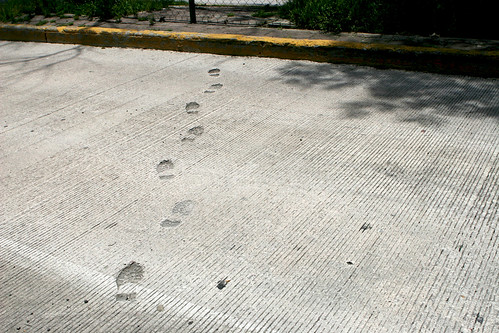
Footprints in the sand wash away when the tide comes in. We sometimes place handprints or footprints in wet concrete to leave our mark for the future. And an old adage for those who love the outdoors is, "Take only pictures, leave only footprints."

Footprints are evidence of where we have been, what we have done. I think it makes sense then that we sometimes describe the trail we live through the online realm as our "digital footprint." But unlike footprints in the sand, your digital footprint is more like footprints left in concrete. Indelible. Hard to remove.

When I used to serve as Technology Coordinator at a K-8 school, I taught a unit on digital citizenship unit for middle schoolers. One of the ideas I shared with the kids was "the Internet has a long memory." Digital footprints, set in concrete.

Perpetual walking
Perpetual walking [Image by pulpolox CC BY-NC 2.0]