The end is in sight for my semester as a student. It's been a very, very busy semester. I'm taking two courses: Research in Education, and Leadership in Educational Technology. Both have been interesting and valuable. Both have been taxing, but in very different ways.
The leadership course especially has been really interesting. We started the course by learning about our own strengths and how those impact our approach to leadership abilities. (We used the StrengthsFinder assessment--it was really helpful for self-knowledge!) One of the key elements of the course was to use a commercial leadership simulation software product, with the idea that practicing skills and techniques in the simulation will translate from the digital sim to real life situations. I was excited from the very beginning to explore simulation-based learning, as this is something I had read of but never really experienced firsthand. The product is called vLeader ("virtual leader," get it?) It has some technical limitations, for sure, but it is an interesting piece of software.
Showing posts with label Simulations. Show all posts
Showing posts with label Simulations. Show all posts
Tuesday, April 29, 2014

Monday, May 13, 2013
The Joys of the Apple II
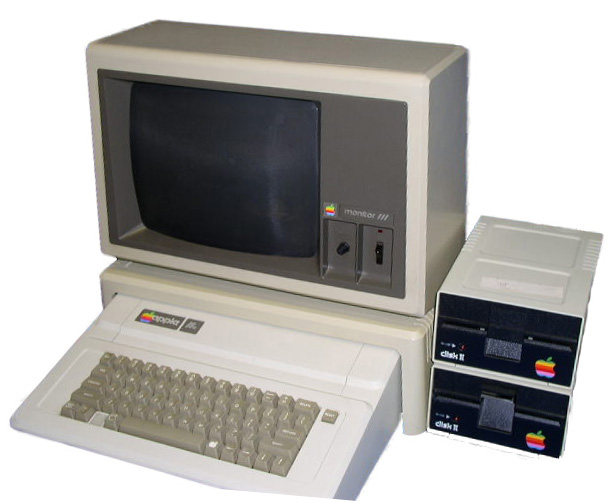 |
| By User Apple2gs, via Wikimedia Commons |
If you were a child of the 80's (and maybe even the 90's), did you have an Apple II (or Apple IIe, or Apple IIgs) in your classroom? If so, here's a bit of nostalgia too good to pass up...
Block off an hour or so and go check out http://www.virtualapple.org/. You won't be sorry.
The site is an emulator for all those classic games you used to play: Where in the World is Carmen Sandiego?, Lemonade Stand, and...the grand-daddy of them all...Oregon Trail!
The games load up right in your browser, but you'll have to install a plug-in for them to load. (This is easy, and free--when you try to play a game for the first time, follow the on-screen instructions and you'll be in game-mode in a matter of minutes.)
Yes, the graphics are just as awful as you remember them. Yes, the sounds are midi-generated silliness. Yes, the games are just as awesome today as they were all those years ago.
And even though the graphics are bad and the sound is worse, I think your students could still learn from these games. Okay, sure: some of them are just ridiculous...but you could say the same for some of the schlocky apps you probably have on your classroom set of iPads today!
It might also be worth sharing this site with your students' parents...just the sort of old-school fun for parents and kids alike for the summer doldrums of "Mom...I'm bored!"
(Thanks to my Twitterfriend @sjunkins for sharing this great site!)
Sunday, April 28, 2013
PBS LearningMedia
Great online curriculum resource to share with you here: PBS LearningMedia.
A selection, just for examples: (with suggested grade levels)
A selection, just for examples: (with suggested grade levels)
- An interactive introduction to chemistry (6-12)
- An interactive means of helping students understand topographical maps (6-12)
- A video interview with Brian Selznick, author of The Invention of Hugo Cabret (4-7)
- A video of ideas for building structures from recycled materials (PreK-5)
- A "President for a Day" game to help students understand the many parts of the President's job (3-8)
And this is just the tip of the iceberg! There are thousands of video clips, interactives, games, and lesson plan ideas. You can search by keyword, or browse by grade level, subjects, standards, or collections to find just the right tool to support your students' learning.
You can check out a few items to see if it's the sort of thing you'd use, and then you are asked to create a free account if you want to use more. Totally worth it! (Plus, it's free!)
No matter what grade level or subject you teach, you're likely to find something here that you and your students will find interesting!
Monday, February 11, 2013
Heifer Village: A Simulation
Heifer Village: Nepal is an interactive simulation to help students think about poverty and community development. In some ways, it's similar to Third World Farmer, but it's more of a simulation than a game, if you want to get into semantic differences.
What I like about Heifer Village: Nepal in particular is that it leads participants through the steps and thought-process of developing a community-centered micro-loan organization. Through this structured simulation, participants can see the benefits of impoverished communities banding together to help each other out. I have dreams of getting students involved in providing micro-loans to such organizations themselves, through groups such as Kiva. (I hope you'll check out Kiva and think about how this organization might help you broaden your students' global view!)
In any case, a simulation like Heifer Village might be the first step. Check it out!

What I like about Heifer Village: Nepal in particular is that it leads participants through the steps and thought-process of developing a community-centered micro-loan organization. Through this structured simulation, participants can see the benefits of impoverished communities banding together to help each other out. I have dreams of getting students involved in providing micro-loans to such organizations themselves, through groups such as Kiva. (I hope you'll check out Kiva and think about how this organization might help you broaden your students' global view!)
In any case, a simulation like Heifer Village might be the first step. Check it out!
Friday, January 25, 2013
Fantastic Contraption: A Physics Simulation
Okay, it's a game. But it'll teach your students some physics concepts and problem-solving strategies in the midst of playing a game. (And who ever said you can't learn anything by playing a game?)

Wednesday, December 26, 2012
A Game to Make You Think
In case you are running stuck with things for your middle schooler (or high schooler, or yourself...) to do over Christmas Break, let me encourage you to play a computer game. But this game is serious. It's a serious game--one intended not only to entertain, but also to educate.
The name of the game is Third World Farmer. The goal: survive as long as possible.

The name of the game is Third World Farmer. The goal: survive as long as possible.
Wednesday, November 28, 2012
The Outbreak at Watersedge: An Interactive Health and Science Simulation
When I was a middle school science teacher, I regularly used online simulations to enhance understanding of the topics we were studying. While a simulation can't (and shouldn't) replace hands-on activities in science class, there are some topics that are just too dangerous, or impractical, or on the wrong scale (too big or too small) for students to manipulate first hand. Other topics are too complex, and a simulation might help simplify the situation.
The Outbreak at Watersedge is a great simulation in this sense. It is an interactive game that simulates a public health crisis in the fictional town of Watersedge. The player takes on a role as an intern in the Watersedge Department of Health. The director of the Department sends the player on errands to take pictures, collect water samples, interview people, and map out incidents of illness to try and figure out why people are getting sick. It's a pretty well-developed simulation, and since it is narrative-based, it is fairly immersive. I'd say it would work well for the middle school crowd in particular, but it could be used for precocious upper elementary students as well.

Of course, no simulation is going to be a perfect fit for every classroom or curriculum. This simulation is a great way to understand how diseases are spread, and what causes epidemics, so it would probably fit best in a unit on disease and immunity or perhaps a science-and-society unit. It gives some practice in thinking scientifically, eliminating possibilities, and basing inferences on data and observations. This could be a great supplement to a science unit you teach!
The Outbreak at Watersedge is a great simulation in this sense. It is an interactive game that simulates a public health crisis in the fictional town of Watersedge. The player takes on a role as an intern in the Watersedge Department of Health. The director of the Department sends the player on errands to take pictures, collect water samples, interview people, and map out incidents of illness to try and figure out why people are getting sick. It's a pretty well-developed simulation, and since it is narrative-based, it is fairly immersive. I'd say it would work well for the middle school crowd in particular, but it could be used for precocious upper elementary students as well.
Of course, no simulation is going to be a perfect fit for every classroom or curriculum. This simulation is a great way to understand how diseases are spread, and what causes epidemics, so it would probably fit best in a unit on disease and immunity or perhaps a science-and-society unit. It gives some practice in thinking scientifically, eliminating possibilities, and basing inferences on data and observations. This could be a great supplement to a science unit you teach!
Thursday, November 8, 2012
A Shooting Star is Not a Star
Do you teach an astronomy unit? Curious about meteors? Are you just interested with stuff crashing into Earth? If so, check out this simulation:

It allows you to simulate the impact of a meteor slamming into the 3rd rock from the sun. You can adjust the size of the meteor, its composition, the speed at which it collides with Earth, the angle of impact, and more. Pretty neat interactive site!
And then, you should give this song a listen...
It allows you to simulate the impact of a meteor slamming into the 3rd rock from the sun. You can adjust the size of the meteor, its composition, the speed at which it collides with Earth, the angle of impact, and more. Pretty neat interactive site!
And then, you should give this song a listen...
Subscribe to:
Posts (Atom)