Showing posts with label Teaching Science. Show all posts

Thursday, May 6, 2021

Concluding a Course: "Sparkiness" in the Classroom

I'm having a bit of a hard time today as I'm working on my end-of-semester grading. It's not that the students have written poorly, or that they aren't showing evidence of their learning--quite the contrary, actually! But I'm having a hard time because I am wrapping up teaching Elementary Science Methods right now, and it's likely going to be the last time I teach this course, at least for a while.

Why is this so hard for me? Well...because I've taught the course 22 times. I started teaching this course as an adjunct instructor back in 2006, and I've taught it every time it's been offered at our institution since then. My quick math says almost 500 students have taken this course with me in that time, which is pretty ridiculous to imagine, now that I'm thinking about it! While I never feel like I have any course "in my back pocket," this is the one that I know inside-out, because I've taught it so many times. And while the course has obviously evolved over 22 iterations, and while I keep bringing in new ideas, and activities, and things to read and discuss...it's also one that feels very comfortable, because I've lived in it for so long.

At the same time, I recognize it's been more than a decade since I taught middle school science on a daily basis at this point. And I have many other hats I wear in our department, many other courses and projects that I'm part of or in charge of. And so, it's likely time for this one to get handed off to a colleague, and with a new member of our department joining us in the fall, it is time for someone else to take this one.

But there is a sense of grieving for me, recognizing that this is likely my last go at this course for awhile. I think it's because I identify quite strongly with this course in some ways, because it's been part of my life for such a long time. There have been times where this course has felt like work, to be sure. But it has been joyful work for me. I love studying creation, and teaching others about it, and teaching teachers how to foster a love of creation in their own students. 

And so, I'm struggling a bit as I grade these final summative projects from the semester, but realizing that this is more about how I feel than about my students' learning. Because you know what? They are taking away some really fantastic things! So many of them are sharing specific things that made a difference for them in the way they think about science as a subject, or about themselves as teachers, or their future teaching practices. Many of them are naming specific ideas or activities from class that they want to use with their own students. I love this! It's humbling to think about the 500-ish students I've had the pleasure of teaching over the years all taking things they learned from my class and using them with their own students. (Ooof. Gives a real sense of the responsibility we have as teacher educators!)

One student wrapped up her final paper with a personal note that just made me grin:

To finish off, the last thing I learned in this course that I want to take with me would be to get my students excited. Your attitude that you brought everyday got us excited. The questions that you would ask and the activities you would follow up with would make us excited. You always brought your all and that was evident when we were learning from you. Even maybe if you were not excited about the content, you “faked” it and you made us excited in return. Or maybe I was tired a day and the energy you brought defiantly helped keep my attention. I think that students need to have that sense of fun in their day and to not always be so serious. Your constant level of "sparkiness" and fun attitude is something that I want to carry with me. 

You know, I'll take that! If nothing else, I hope and trust that my own enthusiasm for teaching, and the way I model this craft for them rubs off on them a little bit. 

And I think I'll be okay not teaching this course anymore. I'll still be bringing my "sparkiness" to all of the classrooms where I have the opportunity to teach!


Image via pixabay.

Wednesday, April 24, 2019

Teaching Controversy

It's that time of the semester in science methods...the time when we are wading back into talking about how to approach teaching (potentially) controversial topics for Christians who teach science. Talking about how to teach topics like the age of the Earth, Darwinian evolution, human sexuality, climate change...it's an adventure, for sure.

I have included some version of this series of lessons as long as I've taught Elementary Science Methods, which goes back to 2006 now...this is my 20th time teaching the course! As I shared with my students in class today, it never gets "easier" for me to teach this content...but it does get "better." What I mean by that is, I recognize that there are a wide variety of viewpoints held by Christians on these topics, and it's always challenging to balance grace and truth. That part just doesn't get easier, and that was true when I was teaching middle school science, and it's definitely still true now that I'm teaching future teachers.

In our last class meeting, I advertised the topic of the day as teaching the age of the Earth, and we did talk about that. But, as I pointed out to my students, we actually spent more time talking about the Bible, than about scientific evidence. I wanted to name this specifically for my students, because I think that so often when (some) Christians ask the question, "So...just how old is the Earth?" the real question they are asking is, "Do you believe that the Bible is literally true, or not?" And I think that's an entirely reasonable question to ask, but it's not the same thing as thinking about the scientific evidence for the age of the Earth.

The Earth seen from Apollo 17
Apollo 17 [Public domain] via Wikimedia Commons.

Tuesday, July 10, 2018

Teaching Science: Argument and Evidence

This tweet showed up in my Twitterfeed today...


I love this so much, and it sums up so much of the philosophy for teaching science that I tried to embody as a middle school science teacher, and now as I teach future science teachers as well.

Thursday, March 9, 2017

Why Science Education Is Essential

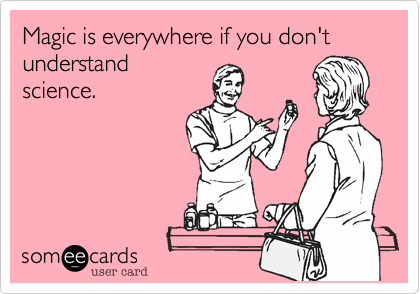
I stumbled onto this great image online earlier today...

Thanks, someecards...

As a former middle school science teacher, I heartily agree. In a society that relies more and more on science and technology, I find it fascinating (and disheartening) to see such an anti-science, and even anti-knowledge sentiment so prevalent in our culture. It's perfectly acceptable to be seen as ignorant, and in some cases it's even lauded.

Don't believe me?

Wednesday, January 25, 2017

Truth and Facts

In my Science Methods class today, we spent much of our time discussing the difference between "facts" and "truth." This feels so germane to so many issues in culture today that it was really something I wanted to talk about--and, serendipitously, it was on the syllabus for today anyway.

I'm using a text by John Mays entitled Teaching Science so that Students Learn Science, and chapter 2 of the book is entitled "Truth and Facts." In this chapter, Mays is really talking about science as a way of knowing about the world. And there are definitely different ways of knowing! Mays emphasizes that science is about developing an empirical understanding of the world--the facts, we might say.

Here are his working definitions for "truth" and "facts": (from p. 17 of the book)

Truth: A proposition that is true for all times, all places, and all people. Truths never change. We know truths by revelation or first hand testimony.
Fact: A proposition that is supported by substantial experimental or observational evidence (data), and which is correct as far as we know. Facts can change as new data and information become known. We know facts by observation and experiment, or by making inferences from our observations and experimental results.

How does that sound to you? Are these helpful definitions?

Friday, January 13, 2017

Science as a Story: Promoting Cognitive Dissonance

I have to confess, I really like messing with my students. I mean, I really enjoy getting them to think about things in a new way, to reframe their previous thinking, to not just think-outside-the-box but knock-it-to-pieces-and-build-a-new-box.

I had one of those moments in my science methods class today, which was a joy this early in the semester. We are right at the beginning; today was our second class meeting. Science methods is a course for future teachers where they learn about how to teach science in the elementary or middle school classrooms they are preparing to enter in the near future. We are at the part of the course where we are thinking about foundational questions, such as, "What is science?" and "Who is a scientist?" and "Why do so many elementary teachers fear (or at least dislike) teaching science?" and "Why does Professor Mulder ask us to do so many weird things in this class?" (Okay, maybe not that last one...at least, not yet. They will be asking that in a couple weeks...)

As part of today's lesson, I asked them to start thinking about the story of science.

Here was part of my presentation, the part where I challenged them to remember what "science class" was like, and gave them a different way of thinking about what "science" could be.


Science Stories? - Created with Haiku Deck, presentation software that inspires

At the point in the presentation where I asked them to think about science as a story (the third slide here,) I had them turn to a partner and take a minute to discuss how "science as a story" fit with their experience with science in school.

It was interesting to see them turn to their partners and sort of shrug as if to say, "Yeah...so...science as a story..." I wandered around the room to eavesdrop a bit, and one pair caught my attention when they said something like, "You got us, Mulder. There's no "story" in science."

And that was the moment when I knew I had them. They were trying to find the connection, trying and failing. But I could tell from their expressions and body english that they wanted to believe it was true, even if just because I was bringing this idea up.

After their minute to discuss was up, I called the class back together, and we talked about how the idea of science as a story would change the experience of science class. What would the students' role become? How would the teacher's role shift? Would the content be experienced in the same way? What would be the same? What would look different?

From there, we turned the corner to their first major assignment for the course: writing a science autobiography--telling their own science story, or perhaps finding themselves in the story for the first time.

---

It was a great class meeting, from my perspective at least. I was able to promote some cognitive dissonance for my students. Cognitive dissonance is just what it sounds like: a "clash" between two ideas in need of resolution, because they can't be held simultaneously. Sort of like playing a white key and a the adjacent black key on a keyboard simultaneously: the sound is dissonant, not harmonious, and is in need of resolution. In my students' case, some of them have negative views of science as a subject--for a variety of reasons--but after our first two class meetings, they are already starting to see that science can be playful, and intriguing, and engaging, and--dare I say it--even fun. This is a conflicting pair of ideas for them. And the idea that "science" can be explored as a story...well, let's just say that I think we are going have to keep working on resolving these ideas, because they are still clashing a bit for some students.

I'm hopeful though, seeing how my students were learning into the playful, hands-on investigations in class, and their level of discussion, and their willingness to explore new ideas--even ones that conflict with their previous experiences--gives me a lot of hope that this is going to be a semester full of learning for us all.


Wednesday, December 7, 2016

When Your Students are a Blessing

Yes, I own a seflie-stick. No I'm not embarrassed about it. I'm also wearing a Christmas sweater
with a T-Rex on it (wearing a Christmas sweater of its own, of course)...so I don't embarrass too easily.

This crew.

This was the group of students I was privileged to teach in my "Teaching Science Pre-K through Middle School" course this semester.

We just has our last class meeting, and I am truly, truly sad to be finishing things up with them.

To celebrate, I brought candy canes, and wore a horrible-amazing Christmas sweater, and we made slime, because science.

This group of students was an absolute blessing for me this semester.

Thursday, April 28, 2016

The Importance of Modeling

Some days, I know that teaching is for me. And I had one of those days recently.

In a recent post, I was wondering about the nature of teaching, and whether teachers are actually "teaching" if their students aren't learning. I sometimes doubt my own efficacy as a professor--am I really cut out for this work? What really qualifies me to teach someone else how to teach? Am I really that effective at this business?

And then I have a moment where I see things coming together...

I have been visiting student teachers throughout this semester, and I have been so proud of my students--seeing them putting into practice the things they have learned throughout their work in our teacher preparation program is gratifying to say the least!

But recently I had an almost surreal experience on a visit one of my student teachers. She was particularly eager to have me visit for this lesson--it was a science lesson. I teach the science methods course for elementary and middle school majors, so she was right: I am always excited to see student teachers leading a science learning opportunity.

The lesson? Part of a unit she was teaching about states of matter. The third graders had already learned about solids, liquids, and gases, and how it's possible to change from one state of matter to another, and what makes these different states function as they do. And today's lesson was a chance for them to check and extend their understanding.

My student teacher began by asking questions of the students, helping them review the characteristics of the different states of matter. I was so proud already at this introduction; in science methods I had emphasized the importance of asking a variety of different kinds of questions--some basic, recall questions, but also higher-order thinking questions--and here she was, using all sorts of questions to engage her students and help conduct them in to the lesson of the day.

And then: a Magic Question...

Friday, November 13, 2015

When Learning Sticks

I had a joyful moment this week.

As a former middle school teacher, it is always just a bit odd for me to have one of my former young-adolescent students in class again now that I am teaching in higher ed. But it happens, and I'm getting used to it.

And, every once in a while, something wonderful happens.

One of my former middle-schoolers-turned-future-teacher caught me before class the other day:

"Hey, Mr. Mulder..."

"Yes?"

"Remember when you taught us about cells in middle school? We learned about how things get in and out of cell membranes? And you taught us about diffusion?"

Wednesday, October 14, 2015

There is DNA in Your Smoothie!

DNA is an actual real thing. DNA is the "blueprint" for how to build a particular organism. Human beings, lobsters, oak trees, bacteria, strawberries, platypus (platypi? playtpuses?)...all living things are made of cells, and all of them have DNA in their cells that contain the instructions for how to build the structures of that particular organism.

Most of you won't be shocked to hear this, I know.

But have you ever wished you could see DNA? How do we really know it's a thing, if it's so small that we can't really see it?

This is a real problem for science teachers. We often are working with things that are too small, or too big, or too dangerous to show students directly. So we create models, or play videos, or show pictures...which are all good options, of course.

Take DNA as an example. When I used to teach students about DNA, I often showed them pictures of the double-helix structure in their textbook. We would view video clips of how DNA can make copies of itself using the microscopic machinery of living cells. I would have groups of students create construction paper models of the ladder-like structure of DNA.

But wouldn't it be nice to show students DNA first hand, if possible?

Thursday, October 8, 2015

Will It Float?

In Science Methods this week we have been learning more about what inquiry-infused science learning looks like. I really like the "5 E's" learning cycle for managing an inquiry-infused science class, and I've been recommending this to my students. (This model was developed by Rodger Bybee and colleagues in the Biological Sciences Curriculum Study; you can read their executive summary if you want more details...)

The 5 E's are a way of organizing learning activities for a student-centered, constructivist approach to science learning. The 5 E's are five "movements" in an inquiry learning cycle that describe what the teacher and students are doing. In a nutshell:

Engage - The teacher provides some sort of hook (a discrepant event, a connection to students' world, etc.) to foster curiosity and set the stage. This provides motivation and a need-to-know to set up the inquiry.

Explore - The students conduct a first-hand investigation to develop their thinking about the science concept to be learned. This movement often exposes students misconceptions about science concepts, and also gives them concrete experiences that can provide the basis of new learning.

Explain - In this movement, both the students and the teacher have the opportunity to do some explaining. The students explain their current thinking, based on their experiences in the Explore movement. The teacher has the opportunity to probe their thinking, ask questions, help them voice their ideas...and provide direct instruction to help students think more scientifically about the concepts being considered. This is the movement where teachers help mediate students' understanding of the content.

Elaborate - The students then have the opportunity to continue working with these new ideas, extending their thinking through another learning activity. This might be another hands-on investigation, further research, or some sort of creative response that incorporates the science concepts. They key is that students continue to develop their thinking about the science content, elaborating on what they have previously learned in the Explore and Explain movements.

Evaluate - Finally, students and teacher work together to find out what the students are now thinking about the concepts. Assessment of learning happens here, with the students (hopefully) able to say, "I used to think...but now I think..."

We had previously learned about the 5 E's learning cycle, but I wanted my students to experience a learning cycle firsthand. So, we took a couple class meetings to learn about floating and sinking, a common elementary science topic. Here's what we did:

Monday, September 7, 2015

Awe and Wonder: Space is BIG

In my science methods class today, we were talking about how to foster a sense of awe and wonder in students. I was sharing with my students how I hope science teachers help their students to have moments in which they simply stand amazed at the way this world has been shaped and created.

As an example, I shared with them this illustration of just how BIG the distances are in astronomy. I actually had all of the balls I describe here collected and ready for illustration. I hope this might foster a bit of awe and wonder for you too!

---

Space is BIG.

How big is it? Let’s make a model…

Image that the Earth is a super-ball about 1 inch across.


On that scale, how big is the moon? Bigger than Earth? Smaller than Earth?

Thursday, August 27, 2015

"Doing Science" with Fortune Fish

I love the variety of courses I get to teach for pre-service teachers. The one I've been teaching the longest is "Teaching Science PreK-Middle School." I began adjuncting this course in 2007, and it has slowly evolved over time to the current state, after 15 or so iterations.

One of the key themes that has not changed, however, is that I have my science methods students "do science" on a weekly basis. That is, we aren't just learning about science; we are actively investigating, observing, inferring, experimenting, and communicating what we discover. I want them to experience learning science this way in the hope that they will carry this approach to teaching science into their own classrooms down the road.

So, when we began the new semester in science methods yesterday, their first assignment is an investigation...

I handed out a little plastic sleeve to each student:

What's in the package?

Tuesday, March 31, 2015

Teaching Science with Slime

I love all of the courses I teach, but I have a special affinity for my elementary and middle school science methods course, a course about how to teach science. You see, I was a middle school science teacher for 8 of the 14 years I spent in K-12 schools, so it feels like a big part of my identity. I love science, and I loved teaching science to middle schoolers, and I still love teaching future elementary teachers (who often seem to fear science a bit at the beginning of the semester) about this subject I love so much.

Tuesday, November 25, 2014

Sometimes We Make Slime

One of the courses I am privileged to teach is Methods of Teaching Science for PreK-Middle School. There are challenges in trying to find activities and resources that can be used for all of those grade levels (teaching preschoolers is, after all, a bit different than teaching young adolescents!), so I try to include a range of different activities: some that might work better for early childhood, some for upper elementary, some for middle school. But there are a few activities that we do in the course that seem to work well with every age group, or at least, can be easily adapted for use with any age group.

For example: sometimes we make slime.

Isn't this lovely stuff? You can make some too.
(The recipe...)

Slimes are so wonderfully yucky and tactile, almost every kid loves to play with them. Even my methods students--adults!--get crazy and excited when we break out the slime.

Recipes for Slime

Science teachers, make some slime and let the kids play!

I was a middle school science teacher for many years, and now I am privileged to teach future teachers how to teach science. Every science teacher should know how to make slime. The kids love it, and there can be fantastic science learning that happens by playing with slime!

My two favorite slimes are easy to make, and don't require any chemicals other than those you can probably find at your local grocery store. Here are the recipes for oobleck and glurch...

Monday, June 2, 2014

The Colossian Force: A Theory of Everything

I first applied to serve as an adjunct instructor teaching science methods at Dordt College back in 2006. I remember that after my interview with the Provost, I was strolling through the Campus Center, admiring some of the artwork on the walls. There was one interesting sculpture hanging on the wall that really caught my attention—bright colors and shapes leaping out at odd angles. I was curious, so I walked over for a closer look.


On the card next to the sculpture there was a note explaining the artist’s inspiration. He had been talking to a scientist who is looking for a “Theory of Everything.” (Maybe you’ve heard of such theories? Basically, the idea is that scientists would love to find one set of laws and equations that will elegantly explain all the forces and energy in the whole universe—gravity, quantum mechanics, electromagnetism…everything!) In the artist’s statement, he notes that the scientist mentioned a “Colossian force” as a possible Theory of Everything. The artist noted Colossians 1:16, 17 as a source for the idea of this “Colossian force.”

I was curious, so I looked it up. Here’s what it says: “For by him, [that is, Jesus Christ,] all things were created; things in heaven and on earth, visible and invisible…and in him all things hold together.” Wow, right? This is the ultimate Theory of Everything!

God surely has created an amazing universe. And the thing that really gets me is this: it all works together all the time! God’s designs are so much greater than we can possibly imagine! This is one of the reasons I love to teach science, and I love to study Creation myself: the more we study and learn about the world God created, the more we can be awestruck at the incredible power and amazing care He has. Thanks be to God!

Wednesday, July 10, 2013

Misconceptions: A Jumping-Off Point for Understanding

I taught middle school science for quite a few years, and I've been teaching a science methods course for half a dozen. It's definitely true that students hold a great many misconceptions. And, frankly, it's often their teachers' fault that they develop these misconceptions. (Pointing the finger at myself here. Guilty as charged...)

The good news: misconceptions can be a great jumping off point for developing understanding! The bad news: it's fiendishly difficult to change people's minds once they have learned something wrong.

An example: Heavy things do not fall faster than light things.

Thursday, March 21, 2013

The 5 E's Learning Cycle: An Inquiring Methodology

In Science Methods today we were talking about teaching via inquiry. This is a topic we've dealt with before, but it's one that students who haven't experienced inquiry-infused science classes before really struggle with. And to be honest, that's most of my students.

So I'm trying to find ways of making it as tangible for them as possible. We do a lot of science together, which helps them to picture it. Today, I wanted to clearly explain some of my thinking behind the way I've structured the activities we've done lately. So I explained that I have been using a methodology termed the Learning Cycle, which is sometimes referred to as the "5 E's." The HaikuDeck below was a key part of our discussion today:


This isn't the only way to teach science, of course. But I've put it into practice myself as a middle school science teacher, and it really does work well as a way of coaching students into doing science, rather than just learning about science.

I find the following ideas crucial for this methodology (which might also determine the success or failure of a teacher's use of this approach):

  1. Don't minimize the importance of the "Engage" movement. Students need to have some sort of hook to get them primed, asking questions, thinking, and ready to learn. Discrepant events are great for this, but there are other great ways to get students engaged. Children's literature and storytelling are also fantastic hooks.
  2. When investigating in the "Explore" movement, do make sure the activity is both hands-on and "minds-on." I've found it works best if this investigation is not a cookbook-style activity (do this, do that, bake at 350°, and you get a chocolate cate), but rather a more open-ended investigation that prompts further questions and pushes students to have to figure things out and make inferences based on what they observe.
  3. In the "Explain" movement, it is SO tempting for you as teacher to be the "Explainer." Fight this urge; this movement works best if the students do most of the talking. They should be the ones explaining their thinking. That doesn't mean you won't be an active participant as well, however; this is a key place to guide the discussion and try to probe for misconceptions, and prompt alternative lines of thinking that will lead to more scientific understanding.
  4. Don't skip the "Elaborate" movement! This is an extremely important part--having the students put the pieces together and demonstrate their new understandings. Whether that be another hands-on investigation (preferably student-designed!), or a research project, or some sort of creative response, this movement is where the new understandings are consolidated and made explicit.
  5. Finally, while the "Evaluate" movement has an air of finality to it, recognize that this cycle is a cycle--the students' elaborating work might prompt further questions, that might be the kickstart of an "Engage" movement for another learning cycle. Evaluating students work need not be an end of learning. Also, the final assessment of a particular learning cycle should not be the only assessment that takes place; ideally, ongoing formative assessment will be part of every movement!
One final note: while we were talking about this specifically as a methodology for teaching science in elementary and middle school, this approach would transfer well to most any subject area and to any grade level. I hope you'll consider giving it a try, and sharing your experiences with putting the 5 E's into practice in your own classroom.

Tuesday, February 26, 2013

Earthquakes!

In Science Methods today we were talking about teaching geology. We did several different activities: mineral identification, modeling the rock cycle, examining plate tectonic maps. I missed sharing this site in class--we just ran out of time! (Too much fun stuff...)

The U.S. Geological Survey has some really great resources to help support science and geography teachers. They have different kinds of maps available, for free, to encourage teaching geology and map skills to students at all grade levels.

In particular, I was fascinated with this interactive map page displaying information about recent earthquakes:

A screengrab from the USGS Earthquakes page.

You can customize the map to show earthquakes of different magnitudes and different lengths of time. It gives precise information as to when and where the earthquakes take place. (The legend button in the upper right-hand corner is helpful for understanding the coding scheme used on the map.) You might be surprised to see how many earthquakes have occurred in the past week or month--truly, we live on an active planet! 

This page could be a great seed for a mini-lesson. How might you use this with your kids?