Showing posts with label Theory and Practice. Show all posts

Wednesday, December 29, 2021

Thoughts on Publishing and on Being an Academic

It's the end of the year, and I'm growing reflective. I'm thinking back over the past year, the things I've done, and the things I've left undone. I deliberately didn't set a lot of goals for this year (in my first post of this year I talked some about that), but informally, I figured I would do some writing, and try to publish a few things. I've become an academic...and that's a big part of what academics do, after all.

One of my proudest accomplishments--academically speaking--of the past academic year was getting an article I co-wrote with two of my professional colleagues and friends published in a highly regarded EdTech journal. Our piece is entitled "Assessing Digital Nativeness in Pre-Service Teachers: Analysis of the Digital Natives Assessment Scale and Implications for Practice," and we got it published in the Journal of Research on Technology in Education, which is a top-10 journal in the EdTech field (depending on the way the question is asked, anyway. I'm basing it on the research included in the chapter "Where Should Educational Technologists Publish Their Research?") Matt and Jake and I have been researching different aspects of the so-called "digital natives" and "digital immigrants" for several years, and have presented some of our research together at conferences, and now have published this piece. It was a lot of work, but gratifying to see our research in print. 

But I recently read this piece from John Hwang entitled "Christian Scholars have a Distribution Problem," and boy did this resonate with me. Hwang's basic argument is that academics are doing great work...but very few people wind up reading/viewing the work because it's often (primarily) done for others within our specific guilds. And this connected with me...because who is really going to read the article Matt and Jake and I published? Honest answer: probably only a handful of other EdTech researchers who are also interested in the digital natives/digital immigrants "construct," and the problems associated with the abject lack of empirical evidence for it.

In fact, I can check how many people have cited our work on Google Scholar...and after a year out in the world, it has been cited by...wait for it...ONE person so far. I hope that a few others have actually read the piece, but I don't really know if they have. And if they have read it, have they found it beneficial in any substantive way?

On the other hand, I write things here on the blog--infrequently as they come--and I regularly have 100+ people read the posts I'm putting out in this format. My most read posts have had 10,000+ reads, though there are precious few in that category; only 3 or 4 over the decade I've been writing on here. But I've had 440,000 views of things I've written on this little ol' blog in that decade, and that feels like something substantial. In contrast, I've had a total of 38 citations of things I've published formally as journal articles, book reviews, and chapters in edited books in that same 10 year period. While I'm quite sure I've had more than 38 people read those pieces that have gone through peer review...it's still a striking difference.

The numbers don't tell the whole story, of course. Certainly there is a difference in these two forms of writing, and the informality of publishing my thoughts-in-process on the blog is WILDLY DIFFERENT than the rigorously peer-reviewed approach to getting an article published in JRTE. Not to mention that I don't typically use my thickest educationese and academic writing style here--it's much more informal writing, and much more of "here's what I'm thinking about in the 30 minutes I had to write this thing" rather than the careful, painstaking, thoroughly-sourced writing in a journal.

But I do wonder about whether the things I write here on the blog have more practical value for the readers than the more academic writing I also do. Is this going to be more likely to spur a conversation between practicing educators than a journal article? I wonder about this, and it makes me think I should keep writing things and pushing my first-draft thinking here.

Or take podcasting as another experiment in informal publishing. Along with my Education department buddies, Abby and Matt, we started recording Hallway Conversations about a year ago. In that time, we have had just about 11,000 downloads over 44 episodes. This means we are averaging about 250 listens to each episode--which is a modest audience by some measures, but I'm incredibly grateful for the dedicated community of regular listeners we've developed over time. We get feedback, questions, and affirmations regularly from our listeners, and this gives us a fair confidence that what we are putting out into the world each week is fostering valuable reflection and discussion, at least for a small number of educators. 

Is there value in traditional, peer-reviewed academic publishing? Certainly. And I'm grateful that I get to do this, and that people have read and cited my work--this is affirmation that it is valued, at least by people in my weird little guild of EdTech researchers.

But is there also value in non-traditional, more informal publishing venues? I think so. And, when push comes to shove...are these going to be more impactful for practice for educators than peer-reviewed articles that are likely to end up behind a paywall or in an academic library on a university campus? I'm thinking that this is likely the case.

The real problem for me is time. I have lots of ideas of things I'd like to research and write about. I'm most limited by the amount of time I have to dedicate to this work that I find so enjoyable! So this prompts the question for me: where should I devote my limited time? Peer-reviewed writing for my guild that is more reputable and reliable, but less likely to be accessed? Or informally-published work that has less prestige, but might have more widespread impact? 

Regardless of the answer to this question, I hope I'll keep doing both for the foreseeable future. And I know I've got a couple of books in me too...it's just a matter of finding the time to start writing them!

Image by Mohammed Hassan via Pixabay

Friday, April 29, 2016

On Teaching "Christianly"

It is the end of the semester, and I have students beginning the review process for their final exams. In Intro to Education, this means reflecting on all that they have read and discussed and studied in light of our essential question for the course: "What does it mean to teach 'Christianly?'"

This is a novel concept for some students. Most all of my students would self-identify as Christians, and most all of them are planning on becoming teachers. So they might well wonder, "Why does Mulder make such a big deal about this 'teaching Christianly' stuff?" And I do make a big deal about it in class. While I don't specifically ask that question each week when we meet up, I allude to it often, and I strive to both challenge their thinking through the things we read and discuss as well as model a distinctively Christian approach to teaching when they see me at work in class.

Welcome to Intro to Ed. Image by Dave Mulder [CC BY-SA 2.0]

I don't do this perfectly, of course. I'm still figuring out how to teach Christianly myself. I've been thinking about this for some time now, and I even shared my thoughts about teaching (and living) "Christianly" on inallthings.org this spring. But I am far enough down this path that I am convinced this is the right way to work out my own discipleship within my teaching practice, and I am trying to demonstrate it for my students.

Sometimes I think they are even starting to "get it." :-)

Friday, October 9, 2015

Grades Should Report LEARNING

I think you may need to know where I'm coming from if you're going to read this post, so you don't think I'm just suddenly ranting out of thin air.

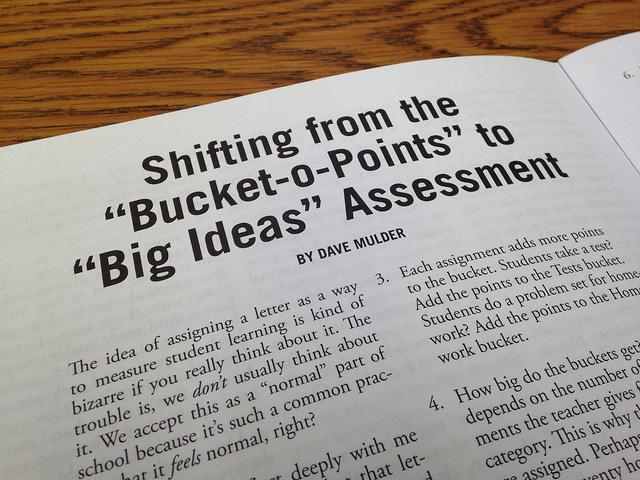
Early in my teaching career, I was all about the points. I've written before about my "bucket-o-points" approach to grading, and how I slowly shifted away from this perspective. (I encourage you to read the article linked above for that story.) But this is still a passion area for me, and I think most teachers aren't nearly mindful enough about our assessment practices, and more specifically, about our grading practices.


Okay, on with the post...

---

I was recently doing some reading in preparation for a lesson I'm teaching next week, and I am using John D. Mays's lovely little book Teaching Science so that Students Learn Science as a text for the course. While Mays is giving advice to science teachers in particular, much of what he has to say applies to teachers in general.

Take this gem, for instance:

Thursday, October 8, 2015

Will It Float?

In Science Methods this week we have been learning more about what inquiry-infused science learning looks like. I really like the "5 E's" learning cycle for managing an inquiry-infused science class, and I've been recommending this to my students. (This model was developed by Rodger Bybee and colleagues in the Biological Sciences Curriculum Study; you can read their executive summary if you want more details...)

The 5 E's are a way of organizing learning activities for a student-centered, constructivist approach to science learning. The 5 E's are five "movements" in an inquiry learning cycle that describe what the teacher and students are doing. In a nutshell:

Engage - The teacher provides some sort of hook (a discrepant event, a connection to students' world, etc.) to foster curiosity and set the stage. This provides motivation and a need-to-know to set up the inquiry.

Explore - The students conduct a first-hand investigation to develop their thinking about the science concept to be learned. This movement often exposes students misconceptions about science concepts, and also gives them concrete experiences that can provide the basis of new learning.

Explain - In this movement, both the students and the teacher have the opportunity to do some explaining. The students explain their current thinking, based on their experiences in the Explore movement. The teacher has the opportunity to probe their thinking, ask questions, help them voice their ideas...and provide direct instruction to help students think more scientifically about the concepts being considered. This is the movement where teachers help mediate students' understanding of the content.

Elaborate - The students then have the opportunity to continue working with these new ideas, extending their thinking through another learning activity. This might be another hands-on investigation, further research, or some sort of creative response that incorporates the science concepts. They key is that students continue to develop their thinking about the science content, elaborating on what they have previously learned in the Explore and Explain movements.

Evaluate - Finally, students and teacher work together to find out what the students are now thinking about the concepts. Assessment of learning happens here, with the students (hopefully) able to say, "I used to think...but now I think..."

We had previously learned about the 5 E's learning cycle, but I wanted my students to experience a learning cycle firsthand. So, we took a couple class meetings to learn about floating and sinking, a common elementary science topic. Here's what we did:

Wednesday, August 26, 2015

Middle School Teachers: American Ninja Warriors of the Profession

I have a new course I'm teaching this year: Planning, Instruction, and Assessment in Middle Schools. I'm so excited for this one! I was a middle school teacher myself for 14 years before becoming a teacher of teachers, and I care deeply about making school a developmentally appropriate experience for young adolescents.

Teaching in the middle grades isn't for everyone.

Thursday, May 21, 2015

Freshman Expectations: "You Aren't In High School Anymore!"

Yesterday I posted a bit about good pedagogy, and technology, and navigating change in today's educational environment. My friend Ed replied and his point got me thinking some more about one part of the discussion fodder I shared in that post in particular: the idea that there is a real difference in expectations for learning in high school vs. learning in college. He was responding to a quote I shared in that piece that came from an article entitled "Message to My Freshman Students."

You see, I teach a lot of freshmen, first year college students. As in, they were just in high school in May, and then show up in my college class in August.

So I'm thinking now about how I can better help the freshmen I teach in Intro to Education understand the difference in expectations for their learning from high school to college. Because if I'm going to expect them to be dramatically different learners than they were in high school, they need to understand the difference.

Friday, April 10, 2015

About Mystery: Getting "Lost" in the Classroom

Lost was my very favorite television show. When it began in the fall of 2004, I had no idea how wrapped up I would become in the puzzles, the characters, the mysteries that were all part of that show.

Lost had a great team of writers, a fantastic cast of actors, and all sorts of crazy connections to history, mathematics, religion, science, geography, literature, music, philosophy, and pop culture.

It was science fiction...but not really.

It was fantasy...but not really.

It was great stories about intriguing people who were stuck together in a bizarre location that only got stranger as you learned more about it, and yet it began to make more and more sense as well.

I recently started re-watching the series on Netflix while I'm on the treadmill in the morning. I was again riveted by the pilot episode...

Tuesday, March 31, 2015

Teaching Science with Slime

I love all of the courses I teach, but I have a special affinity for my elementary and middle school science methods course, a course about how to teach science. You see, I was a middle school science teacher for 8 of the 14 years I spent in K-12 schools, so it feels like a big part of my identity. I love science, and I loved teaching science to middle schoolers, and I still love teaching future elementary teachers (who often seem to fear science a bit at the beginning of the semester) about this subject I love so much.

Friday, December 26, 2014

Technology Does Not Replace the Teacher

This year I'm serving as an instructional technology coach for my fellow faculty members. It has been interesting getting started on this--it's a new position at our institution, and I'm sort of making my own way. I've been working with colleagues on an as-needed basis to support online teaching, to work with how to use our CMS to support instruction, and to brainstorm ideas for other tech tools they might use to support their teaching.

While I've been met with a mostly positive response so far, and quite a bit of gratitude for my willingness to help with their concerns about teaching with technology, I've had a few interactions this fall with colleagues who seem very skeptical about the value of technology to support teaching and learning. They seem to view technology as a stumbling block, or even a negative influence in the classroom.

I think I understand where they are coming from. Teaching with technology can be daunting, and particularly if one doesn't feel personally comfortable with the technologies at hand. And even being comfortable using a particular technology does not mean one is comfortable teaching with that technology.

Thursday, November 6, 2014

How Should We Be Using Technology in Schools?

I admit that I'm a technophile, and I generally advocate for the use of technology in teaching (though I take "technology" pretty broadly...I've said before that a pencil is an educational technology...)


I recently came across this article from Forbes via Twitter: It's Time to Rethink Our Use of Technology in Schools. No matter if you consider yourself a technophile or a technophobe when it comes to using technology for teaching and learning, I hope you'll take the time to read it an reflect on what is being presented here.

Several provocative points that stirred my thinking:

"There is evidence that where schools and colleges use technology effectively there is a correlation with better outcomes. But that is not the same as saying the technology is actually aiding learning. It is not the technology that makes a difference, it is the teachers." (emphasis mine)

--> This is very much what I'm thinking right now. We often get pretty wound up about the possibilities of the tools, but good pedagogy still makes the most impact. Technology does not--and truly cannot--replace a great teacher!


"Five ideas for tech integration from Martin Blows:

  • Exchange: swapping traditional ways of doing things with ICT
  • Enrich: engaging learners with a richer mix of media
  • Enhance: encouraging deeper learning through the use of ICT
  • Extend: encouraging students to take their learning further
  • Empower: giving students control over their own learning

It is not the technology itself that is important, it is how it is used. And this requires investment not just in equipment but in giving teachers the confidence and competence to exploit it."

--> I love the five E's here, but I'm not so sure that "Exchange" is a good enough way to use EdTech. If it's a straight up swap, I'm not sure there is enough of a value-add for using the technology vs. not using the tech. My 2¢...

What do you think? Are there other great things that stand out for you here?

Sunday, October 19, 2014

We can't just hand them computers...they might learn something!

I confess it...I went through a kick sometime in the past year or so where I made a bunch of snarky graphics at someecards. In the batch someplace was this one:

I had used it to illustrate my point for a blog post about the way so many 1:1 programs are structured--very similar to what Cuban (2013) argues--as if the use of educational technology is some kind of magic bullet that will suddenly cause amazing learning to happen.
Actually, as I reflect on this, I think the silly graphic here isn't telling the truth. I think we can expect that kids will learn things if we hand them a laptop connected to the Internet. The problem is, in formal educational settings, we generally want to control just what it is that they learn, and ensure that it is focused on some broader educational goals or standards or scope & sequence of prescribed learning outcomes.
And this seems to be just the opposite of what Mitra is arguing for. Mitra et al. (2005) emphasize this in their very hypothesis: "if given appropriate access and connectivity, groups of children can learn to operate and use computers with none or minimal intervention from adults" (p. 2). For me, the question remains "Is this good enough?"

Sunday, September 7, 2014

7 Attributes of Great Teachers

What characteristics does it take to become a teacher? Or, even better, what attributes describe great teachers? When you think of great teachers you know or have had, what stands out to you about them?

Thanks to my Twitterfriend, @johnccarver for sharing this gem.

I have been a professional educator for 17 years now, and while I have come to the point where I can say that I'm a good teacher, I'm still learning, still striving to get better. But here are the seven things I know for sure all great teachers have in common.

Tuesday, August 5, 2014

The Nine Teachers You Meet at School

My son and I share a common bond in our love of Legos. Yesterday I snapped this picture of a sort of bizarro "Super Friends" team assembled from our collection:

216/365
Quite a team, right?

This morning, I started thinking (and laughing) about this picture again, and my thoughts turned toward teaching. This crazy picture reminded me of the many different approaches teachers take to their teaching practice. So, if you'll indulge me, here are the nine teachers you meet at school:

Thursday, July 17, 2014

Meaningful Learning

I just came across this image in a SlideShare presentation by Catherine Cronin:

This image is a screencap from a presentation by Catherine Cronin (@CatherineCronin.)
Used with permission.
As I reflect on how I conduct my teaching practice, this is so much of what I'm striving for with my own students.

Yes, there are still facts students need to commit to memory.

Yes, there are basic skills students need to practice toward mastery.

Yes, there is a time and a place for drill and practice.

But overall, I think learning is more meaningful when we get beyond these "just the facts" approaches.

Think about your own learning preferences, teacher. Do you learn the most from sit-and-get professional development? Or are you more engaged when you have the chance to discuss and interact with fellow learners? Collaborate in working toward a goal? Thoughtfully reflect on readings and conversations?

Recognize that your students may have different needs than you do as a learner because of their age...but how satisfied would you be with learning if it was always...
  • reproducing someone else's ideas, 
  • receiving other people's thinking about ideas, 
  • repeating the same tasks over and over, 
  • driven by competion with fellow learners for attention, for opportunities, for grades, or 
  • prescripted learning with no choice for what or how you learn?
How meaningful would that learning be?

Tuesday, July 8, 2014

Getting Beyond Low-Level Tasks

Let's be honest: much of what passes for learning in many schools today is relatively low-level tasks that don't require too much on the part of students.

Curriculum developers don't help this situation, and tend to try and pre-package easily-digestible bits for the students.

Teachers (pointing the finger at myself here, at least early in my teaching career) are all too willing to follow the canned teacher's manual or pacing guide to move students through the steps.

We must provide them with practice to ensure that they remember the key facts and ideas! Worksheets galore!

How will we know if they have learned it? If they can appropriately regurgitate cut-and-dried responses to questions on tests, they must have learned it, right?

You may be getting a sense of my cynicism about this kind of teaching. My fear is that this approach continues to minimize the role of the teacher to a mere technician: get the kids to jump through the right hoops, press the right buttons, fill in the right bubbles on the sheet, and you've done your job, right teacher?

Let's commit to moving beyond just going through the motions to actually engage our students. Real learning is messy, complex, and multi-faceted. Let's ask our students to do work that gets beyond simple low-level tasks.

How shall we do this?

Thursday, July 3, 2014

Outdated Technology and Outdated Pedagogy

Found this one via Twitter this morning (thanks, @BSGSCSFoster!) It's a gem, and well worth the eight minutes to watch it.


I laughed, but honestly, the Apple IIe from my elementary school days--clunky and odd as it looks today--stirred a passion for educational technology that brought me to the point where I'm now working towards a doctoral degree in the field.

I know that many people sing the praises of all things technological in schools, as if stirring more iPads and SMARTBoards and student blogging and mystery Skypes into the mix will automatically make teaching better, and learning better, and schools, in general, better.

I know that many people also decry technology in school, fearing that we are throwing the baby out with the bathwater in our rush to replace old and "outdated" teaching methodologies, techniques, and tools with new technologies.

But I think that setting this up as a fight between technology and pedagogy is a fallacy.

It's not an either-or proposition.

While I'm a technophile, I like to think I'm a reasonable technophile. I do advocate for technology in education, I admit. But I advocate moderation! Honestly, I believe that good teaching comes first. Technology shouldn't (and truly can't) replace a great teacher. Strong pedagogy trumps high technology every time.

But does that mean we shouldn't (thoughtfully, carefully, wisely) include technology in education today?

I say no.

We need to recognize where we are and when we are. North American culture today is high tech, thrives on novelty, and emphasizes individualism.

Please hear me well: I'm not saying we need to cater to this in schools. I am saying we need to recognize the power of these cultural forces, and recognize that our students have been shaped since birth by this culture. We need to teach the students we have in our classrooms today, be responsive to them. We need to recognize that they may have proclivities to technology, and be willing to adapt our teaching accordingly.

But that does not mean we need to chuck everything we are currently doing to embrace the electric glow of the future. In fact, I think we need to be ruminate on how we can redeem educational technologies, and use them to wisely to enhance our teaching and learning. Simply having them present will not do this. But, neither will simply excluding them.

Being deliberate about incorporating technological tools when it makes sense to do so (because it will have a positive impact on your teaching or on your students' learning) seems like a wise rule of thumb to me.

Today's state-of-the-art, cutting-edge educational technology will eventually be outdated and almost seem like a joke in light of what will then be the norm. But that may be true of some of our pedagogical practices as well.

Image by Neil Turner [CC BY-SA 2.0]

Saturday, June 28, 2014

Cognitive Presence, Social Presence, Teaching Presence

I have taught online for the past three summers,  and this summer it has felt like a welcome respite to take courses online instead of teaching them. It is good for me to be in the student's seat, and to think about online teaching and learning from the learner's perspective. It is interesting for me to be learning about teaching in an online setting. Since I already have some first-hand knowledge--I have taught five or six courses online now--one might think I have expertise in online teaching. And I suppose I do, to a point, but the things I have learned have mostly come through trial and error so far. This course has been a fantastic way to rethink not only what I am doing as an online instructor, but why I am doing it that way.

Specifically, one of the things I have been wondering about is how to build teaching presence in an online course. Since the courses I teach have been mostly asynchronous (we rarely have meetings in which we all are logged in at the same time to share in realtime), it has been a challenge for me to try to replicate what I do in face-to-face courses.

Alt/Option
Image by Phil Norton [CC BY-NC-ND 2.0]


Sunday, June 15, 2014

Becoming a Digitally-Competent Teacher

It kind of drives me crazy when educators try to argue that they don't need to be tech savvy. Yes, it takes work to keep up with rapidly changing technologies. No, not every new tech tool (toy?) needs to be adopted into a formal education setting. But it's not 1989, people. I think it's safe to say that computer technology is firmly in place in schools. And, yes, there has been a shift in the expectations for teachers because of this.

But it's not as if this kind of shift hasn't happened before.

Thursday, May 15, 2014

Switching Off and Slowing Down


A couple weeks ago my wife--whom I love deeply, and so often understands me better than I understand myself--caught me checking my email on my phone at 11:30 at night. I tried to defend myself--lamely--by pointing out the little red icon next to the mail app indicating all the new messages I had waiting for me. Her lovingly-stated solution was elegant and simple:

"Why don't you turn off the notifications?"

Yep. That's right. I can turn them off.

(Thank you, dear.)

---

Interesting to find myself a slave to the device. I like to think of myself as a thoughtful user of technology...and in general, I'd say I am...even though I'm an admitted technophile.

Tuesday, May 6, 2014

Feedback and Grading

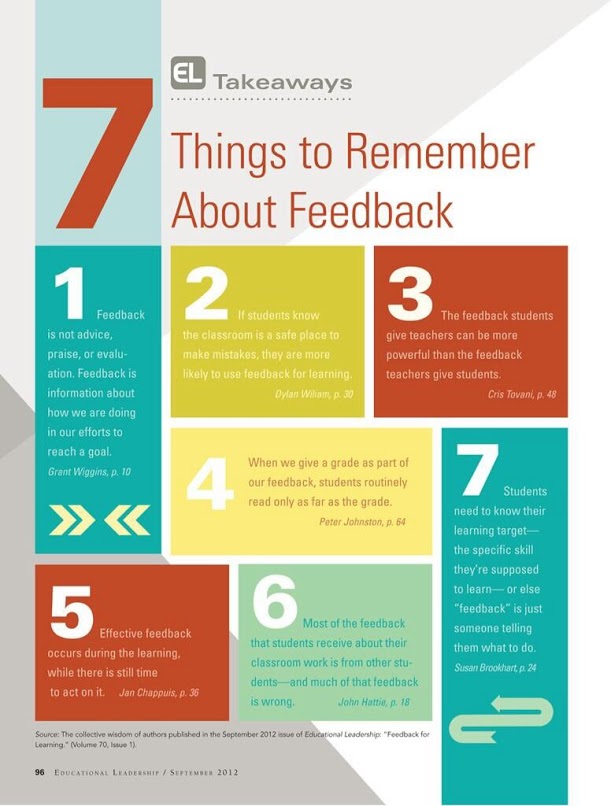
I came across this great graphic from Educational Leadership while browsing on Zite the other day.

It was a good, if challenging, find in light of where I am in the semester. Here at the end of the semester I find I am so focused on exams and marking and assigning grades that I don't always think about feedback as much as I might at other times in the semester.

So I'm thinking again about my students' learning. What am I most interested in? That they can check everything off as "completed" on a list of tasks? That they have submitted all of their assignments? That they score at least 80% on their final exams? Or that they really learn the material?

If I want them to really learn, I think it has to be more about feedback than about "grading." The takeaways below challenged me to think again about the role of feedback. 

It's not all about the grade. It's all about the learning.


As shared by edte.ch