Showing posts with label Assessment. Show all posts

Monday, September 28, 2020

When Are Those Assignments Due?

What time are assignments due for your class? Most learning management systems (LMSs) have a default time of midnight. But do assignments need to be submitted by midnight? Why is that the magic hour?

I'm on a mailing list from Faculty Focus, a resource for instructors in higher ed. Today's email had the subject "Cinderella Deadlines." I thought that was clever enough to click the link to this article: Cinderella Deadlines: Reconsidering Timelines for Student Work. It's good stuff, and it echoes much of what I do for my own courses, most of the time.

Why have assignments due at midnight? It's not like I'm sitting there waiting to get started on the grading at the stroke of 12, after all! So why not reimagine due dates a bit?

For my face-to-face courses (and the hybrid-flexible courses I'm teaching this semester) I set my assignments to be due by class time. If class starts at 9:25 a.m., assignments are due at 9:25, right? Makes sense.

So now I'm reflecting on my practices for online courses. I generally an approach more like the "due dates are arbitrary and give a nudge for the procrastinators" (like me.) What I mean by this is, I know often need a deadline as a student, or else the tyranny of the urgent means other things will crowd out the assignment in question. So I do have due dates...but I'm generally pretty easy on these. If a student doesn't have the work in at a particular time, does that mean they didn't learn the concepts?

I know, I know...work habits and all that business. Yes, there are external obligations and students do need to learn to comply with those obligations. But in all seriousness...most due dates are arbitrary and are set for the teacher's convenience. 

My encouragement: use due dates in your LMS to set deadlines...but be gracious. I suspect most of us would respond well to a little extra grace in our own lives, yeah? So as long as there isn't some compelling reason that a particular assignment must be submitted by 9:25 a.m. (or midnight?), maybe a little flexibility could be a blessing for a student in your life?

Image by Rishabh Agarwal via Unsplash


---

(This post is part of a series offering tips on distance teaching. You can read more about this project here: Distance Teaching Tips. You can also read all of the posts in this series here: Distance Teaching Tips Series.)

Tuesday, June 23, 2020

Can Learning be "Virtual?"

Over the past few weeks I've been doing a lot of consulting work with several schools who are preparing for the fall semester. I've been doing some professional development for teachers, and helping school leaders think through some pedagogical and technological decision-making as they develop multiple options for what the fall might look like for their schools.

It's interesting to see what has been common experiences for many teachers in different parts of the U.S., and what is unique to particular places as well. Overall, I could summarize the online teaching experiences of teachers with whom I have interacted as challenging, exhausting, and not entirely pleasant. (And that might be putting it all very nicely, honestly!) Many educators have found the distance teaching adventure of Spring 2020 to be demanding, to say the least!

But one comment I heard from a teacher in one of these meetings really grabbed my attention. In fact, I paused to scribble it down right when this individual said it:

Friday, September 20, 2019

Grading and Feedback

Yesterday, I received an email from one of my amazing and thoughtful students. She is currently in a field experience placement where she is practicing the "real work" of teaching, including providing feedback to her students. The subject of her email was "Grading and Feedback," and I'm sharing it here with her permission (edited slightly for confidentiality):

Hello Dr. Mulder,  
I have been doing my field experience practicum in a sixth grade class and have been learning so much. One thing that I have been recently faced with is grading and giving feedback and you came to mind. I gave the students a summary exercise in which they had to write a summary paragraph. I am now reviewing these and am realizing my inexperience with grading REAL kids’ work! 
I don’t want to kill their joy for learning, but I also want to give the valuable feedback that will help them grow. How do you strike this balance (especially in middle school)? 
Thank you for your time in considering this.  

First off, how great is this? A pre-service teacher who is in transition to the work of a professional teacher, and she is beginning to realize the challenging nature of our work as educators. But rather than just foundering, she is soliciting input! I'm honored that she reached out to me--not that I have this all figured out, of course--but the key thing I'm thinking about here is the importance of mentorship and support for novice professional teachers.

Here is what I shared with her in response:

Thursday, February 28, 2019

Licensure, Testing Pressures, and Appropriate Teacher Pay

Oh. My. Word.

I just read this article from Education Week: You're More Likely to Pass the Bar Than an Elementary Teacher Licensing Exam.

There is a LOT in this article worth thinking about...but this jumped out at me: "Just 46 percent of teacher candidates pass the test on their first attempt—that's lower than the first-time pass rates for doctors, nuclear engineers, and lawyers on their licensing exams. In fact, the only lower initial pass rate is the multi-part exam for certified public accountants."

Whoa.

Thursday, May 24, 2018

Calling Final Exams into Question

Oh. Snap.

A tweet from one of the people I've been following on Twitter since almost the beginning, Dan Meyer:


Calling the grand tradition of final exams into question seems...almost heretical.

But does he have a point?

I guess I'm now thinking about what the real point of final exams might actually be. Are they intended to provide new insights into student learning? Or are they a way to help students summarize and synthesize everything they had the opportunity to learn over the term? Or...maybe...they are a mechanism for compliance, a way to keep the kids (fearfully, stressfully) "engaged" (not sure that this is the right word for it...) until the end?

Is there value in in continuing the practice of final examinations?

Or is this an outdated vestige of educational practice from days of yore?

What do you think?

Image by Shannan Muskopf [CC BY-NC 2.0]

Thursday, November 16, 2017

Learning to Teach Again: Testing Trials

I am a big believer in closely matching my assessment vehicles to what I want students to know, understand, and do. I think that they way we assess students matter, and I try to use a variety of different kinds of assessments to help me understand what my students understand. This means I use some very informal in-class assessments like quick-writes, Padlet boards to capture their questions, and even monitoring the conversations in small group discussions. But this also means I use a variety of formal, summative assessments that require students to synthesize their learning.

In other words, yes, I give tests.

Thursday, October 19, 2017

Learning to Teach Again: Quizzing Basic Knowledge

Over the past 20 years I've served as a professional educator, my thoughts on basic knowledge and skills have fluctuated.

Early in my career, I know I focused a lot on "just the facts." Students in my math classes learned algorithms for solving particular kinds of problems. Students in my science classes memorized a lot of definitions for vocabulary. The idea for me: they have to know the facts! And...perhaps cynically...it's easier to assess their factual knowledge than the deeper understanding that I hope they will also develop.

Looking back, I now realize that about five years in to my teaching career, a shift began to happen. As I matured as a teacher, I began to de-emphasize basic factual knowledge and instead began to focus more attention on ensuring that students could actually do something with that knowledge. Eventually this meant I embraced standards-based assessment practices for my science classroom, focusing on giving students multiple opportunities to both learn concepts as well as demonstrate their understanding of the concepts. I remember having a (somewhat heated) conversation with a colleague during this time in which I said something like, "If they can find the answer on Wikipedia in under 30 seconds, they don't need to memorize it!"

Monday, September 25, 2017

Learning to Teach Again: Writing Tests

It's time for our first test of the semester in World Regional Geography. I've spent quite a bit of time over the past few days working on writing it. This perhaps something the non-teachers out there don't realize: writing a (good) test is actually a lot of work!

Yes, I know there are lots of pre-fab tests that come with curriculum materials. In my experience, these vary in quality quite a lot. Some of them are pretty good. Some of them are pretty awful. Most are somewhere in between, perhaps with some great questions and some...less great questions.

I generally prefer to write my own tests though, and in this course in particular--while I do have a great text that we're using--I don't have a teacher's manual the way I did when I taught in K-12. And, honestly, I really prefer to write my own test questions anyway.

I've shared my strategies for writing test questions before on this blog, and I'm putting them into practice as I've been working on this test. It's been a timely reminder for me about the challenges of writing good questions: questions that get at what I most highly value, and not just what is easy to measure.

Image by Alberto G. [CC BY 2.0]
(Funny, because I never use Scantron sheets for tests I write...)

Thursday, August 31, 2017

Learning to Teach Again: Pre-Assessment

An old gradebook from when I taught middle school...
Time for me to practice what I preach, folks. If I tell my Education majors something is good practice for teachers, I better be doing it in my own teaching, right?

In my pedagogy-oriented courses, I often emphasize the role that assessment plays in teaching. I often talk with my students about the importance of setting objectives, aligning appropriate assessment vehicles to these objectives, and then ensuring that our instructional moves will actually support students' learning of those objectives. When I say "assessment vehicles," students often jump immediately to tests and quizzes, but there are, of course, lots of other possible ways to assess students' knowledge, understanding, and skills.

Sunday, February 19, 2017

Feedback: Timely, Specific, and Actionable

It has been an incredibly busy season of writing for me lately. My dissertation is coming together, and in fact, I have finished writing all five chapters! That doesn't mean the work is complete, however. There are ongoing edits, and then the preparation for the defense when there is a "final" document ready. But it feels really, really good to be at this point.

The best part of being "finished" is that there now is THE THING that can be addressed for the edits. My advisor has been fantastic throughout this process: he gives me feedback that is timely, specific, and actionable, and the turn-around for his comments on each draft has been amazing. I am able to see the strengths and weaknesses of different sections of my writing, where the ideas are solid, and where I need to rethink things. Each draft I work through is a little better than the last, and I am confident that the next draft is going to be even better than the last one I submitted. (At this point, it feels like there is always a "next draft"...but I know the time is coming when it's going to be good enough.)

My writing desk...it's getting worse, but the writing is getting better...

This experience has me thinking about the way teachers provide feedback to their students.

Saturday, October 8, 2016

Opinions: Evidence of Thinking

"Hey, Professor Mulder...is this an opinion question?"

A few semesters ago, I had a student taking a test raise her hand to call me over with this concern. She was in the midst of of the test, doing her best to answer carefully, and the thought must have struck her that there were multiple "correct" answers to the question I was asking.

Not every question I ask on a test is cut-and-dried. Some are. Some questions are convergent: there is clearly one correct answer. Convergent questions are usually best for assessing relatively low-level knowledge and understanding. Can the students recall the facts? Have they mastered the vocabulary? Do they have an understanding of the basic concepts? Convergent questions are good for these sort of course material. By asking a convergent question on an exam, I am verifying that my students have mastered a particular concept. And this is valuable in it's way; there are concepts that I want all of my students to learn, and a convergent question is a way of focusing in on their knowledge of a particular concept.

However, I don't think that convergent questions are always the best questions, even on a test. I want my students to provide evidence of thinking, not just rote memorization. How will they use the basic concepts they have learned? I've written before about Bloom's taxonomy of cognitive objectives. Bloom's taxonomy is one way of thinking about different levels of thinking. Here it is in a nutshell:

Thursday, January 14, 2016

Do You Have the Guts to Ask?

Image by Alan Levine [CC BY 2.0]

After my last post, I tweeted a series of questions, challenging teachers (I suppose) to try asking their students for feedback about their teaching. Here's one:


Tuesday, January 12, 2016

Satisfaction in Learning

My friend, Erik Ellefsen, recently tweeted this one to me:

Interesting thought, isn't it?

To what degree should we be concerned with student satisfaction? As an instructor in higher education, I am acutely aware of my end-of-term evaluations, and sites like Rate My Professors (I don't look at my reviews there...yikes...) that allow students to sit in the evaluator's seat and give the instructor a "grade." It's a tricky dance; it certainly feels good to have students give you accolades about your teaching...but does that mean catering to what they want, to their whims? Or does that mean challenging them with what they need...even if they don't necessarily want it? What is the mark of satisfaction in learning?


Friday, December 11, 2015

Let's Fix Homework

In a recent post, I shared some of the research that has been done about homework and it's effectiveness (or lack thereof) for helping elementary, middle school, and high school students learn. This has led to a lot of conversations with fellow educators, both face-to-face, and via online connections. It's clear to me that this is something teachers feel pretty strongly about...and to be fair, I have some strong opinions on this topic as well.

I think we can do better than what we've "always done" with homework. I don't think that much of the homework assigned in schools today is doing what we think it is doing. And, if I'm going to say it baldly, I think some teachers are being downright lazy in the work they assign to their students.

If we're serious about helping students learn, let's make sure that the work we assign is really going to help students learn. And that goes for in-class work, certainly, but for out-of-class work too.

Teacher, how confident are you that the assignment you are giving your students is really going to help them learn? I mean, really help them learn, and not just be "something for them to do" or "something that I can grade and put in the grade book."

My friend, Alice Keeler, recently tweeted about something that got me thinking. She is a fantastic teacher, and is thoughtful about her teaching practice. In a series of tweets, she pointed out that throughout her professional training as an educator--both in undergraduate teacher education courses as well as her Masters degree--she was never instructed in how to create "good" homework. And as I reflected on this, I realized that the same is true for me. We mentioned homework in passing in several courses, but we never really talked about how to really create homework that was well-designed to help students learn. And now that I'm a teacher educator...I'm thinking that I'm probably doing a disservice to my students--future teachers--and even to the students and families they will eventually serve; we better talk about homework now!

This makes me wonder about how many of the hundreds of thousands of professional educators in the world today have ever really thought deeply about the quality of the homework they assign. Are we really assigning homework because we are sure it will help students learn? Or are we assigning it because we feel like we "ought to" or out of some vague sense of, "Well, I'm sure homework helped me learn...so I probably should assign some to my students too...?"

We can do better than that, teachers. Let's fix homework.

Image by Corey Seeman [CC BY-NS-SA 2.0]

Sunday, December 6, 2015

No More Crappy Homework

Please forgive me for using "crappy" in the title of this post if that language offends you. But I decided to start things off this way, because it describes the quality of work so many teachers assign. I am pointing the finger at myself here first of all. I have assigned my share of shoddy, low-quality, busywork over the years.

I just read this brief piece from Edutopia, entitled "Homework vs. No Homework Is the Wrong Question." It's good stuff; thoughtfully written, and thought provoking. Here's one great quote to illustrate:
A realistic homework strategy should be a key topic of back-to-school night and the first parent-teacher conferences of the school year. But it should also reflect a considered school policy and not simply be up to each individual teacher to carry out according to his or own theory of student learning.
This makes sense to me. In every school I've taught in, homework is largely left to the discretion of the classroom teacher, other than some vague assumption that "teachers should assign homework, because homework helps kids learn." I'm not so sure that last statement is true--read on to find out more about this--but there are some strengths to this approach, I think. Teachers can be empowered this way to make the best decisions for their individual classes, and even individual students this way. Teachers are--in theory, anyway--the closest to the kids in terms of their learning, and should be the ones to determine the kind of homework that will help students learn most, and learn best. (Again, I'm not sure that is what is actually happening in schools, but in theory, this ought to be the way it works.) But all that said, I also understand the importance of a school homework policy. Having a school-wide policy makes it much more likely that the kind of homework assigned is in fact aligned with the mission and vision of the school.

I wonder if individual teachers who might clamor for the power to make their own decisions about the homework they assign would buck at a school-wide policy? I confess, I probably would, depending on the way the policy is written. For instance, if a school homework policy would prescribe a certain amount of homework that must be given each night...well, I would probably be pretty strongly opposed to that. My fear is that to meet a particular homework quota, even more shoddy, low-quality busywork (ah, crappy homework...) would be assigned.

It's not that homework has no benefit whatsoever. Some homework has been shown, in some situations, to have some positive effect on students learning.

Tuesday, November 24, 2015

The Problem with Grade Books

Grade books are a real problem, and I don't think enough teachers are actually thinking about how they use their grade books.

A grade book is intended to help keep track of student learning. But I wonder sometimes about this. The very design of a grade book is--whether digital or analog--to record symbols intended to represent a certain quantity of learning. Every piece of evidence a particular assessment vehicle provides has to be evaluated--measured, quantified, and scored--in order to be recorded in a grade book. Grade books are generally not designed to capture rich, holistic information. They are designed to capture tiny bits of information distilled and consolidated into symbols--points, scores, percentages, letters--that are easy to record in the tiny boxes that make up the grade book.

This is a photo of one of my first grade books. Look at all those "10's!"

And...there's the problem, I think. The technology of a grade book dictates how we use it. (And make no mistake, it's a technology, whether it's in digital or analog format. Curious about that idea? Here's another post that might help you understand my thinking on this concept of non-digital tools being technologies.) As the quote attributed to Marshal McLuhan puts it: "We shape our tools and afterwards our tools shape us."

Wednesday, November 4, 2015

How Should We Assess Assessment?

This is sort of a weird question I've been thinking about: "How can I best assess my students ability to assess and evaluate?"

I teach future teachers, and I have been thinking about assessment and evaluation a lot lately, because we've been learning about this in my "Planning, Instruction, and Assessment in Middle School" course. (Formerly known as "Middle School Curriculum and Instruction"...we are changing our focus a bit to better capture the key tasks that make up our professional work as teachers.) The students in this course are learning for the first time some of the rigors of the work of teaching: what is actually involved in the planning process at the lesson level? The instructional unit level? The whole course level? How do we know what our students know, and how do we understand what our students understand? How do we actually teach something to someone else?

I am trying to make this course both theoretically-informed, but also practically relevant for them. For example, in our assessment unit, we have talked about all sorts of assessment- and evaluation-related topics, from different choices for formative and summative assessments, to the value of standardized tests, to how to create rubrics and criteria charts, to whether it is ethical to grade on the curve, to how standards-based assessment works, to how to write different kinds of test questions, to what grades really mean. I'm striving to make it a pretty comprehensive course. It also has a lot of meta-analysis...I'm encouraging them to dissect my own instructional decision-making (which is a little scary, to be honest) to see how well I'm modeling and illustrating the things we are learning about at both a theoretical and practical level.

Saturday, October 17, 2015

What is Really Important?

A dear friend who is a social worker shared this via Facebook this morning...

From the Iowa Foster & Adoptive Parents Association's Facebook page.
This is a real concern.

Really.

Kids struggle with depression.

Let me say that again:

Kids. Struggle. With. Depression.

This is a real thing, and if you a teacher, a parent, or work with young people in any way, you need to be aware of this.

Friday, October 9, 2015

Grades Should Report LEARNING

I think you may need to know where I'm coming from if you're going to read this post, so you don't think I'm just suddenly ranting out of thin air.

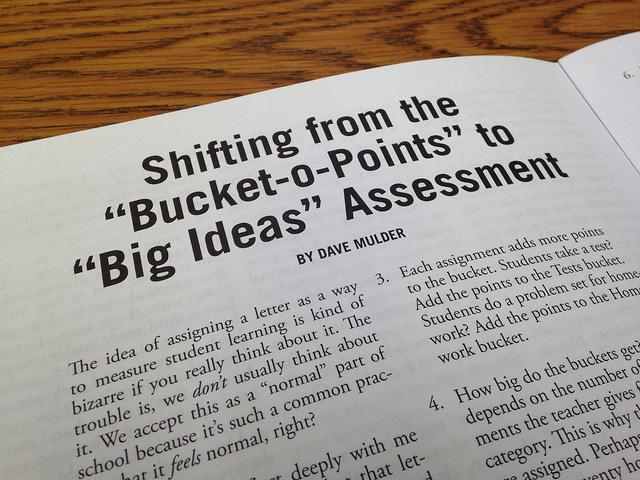
Early in my teaching career, I was all about the points. I've written before about my "bucket-o-points" approach to grading, and how I slowly shifted away from this perspective. (I encourage you to read the article linked above for that story.) But this is still a passion area for me, and I think most teachers aren't nearly mindful enough about our assessment practices, and more specifically, about our grading practices.


Okay, on with the post...

---

I was recently doing some reading in preparation for a lesson I'm teaching next week, and I am using John D. Mays's lovely little book Teaching Science so that Students Learn Science as a text for the course. While Mays is giving advice to science teachers in particular, much of what he has to say applies to teachers in general.

Take this gem, for instance:

Thursday, September 17, 2015

"This is hard!"

"This is hard!" one of my students exclaimed in class this afternoon.

It is my middle school curriculum and instruction course; in the catalog, we call it Planning, Instruction, and Assessment in Middle Schools. Basically, it's a general methods course for thinking about what teachers do (plan, instruct, and assess) and it's tailored to folks who are hoping and planning to teach in grades 5-8.

It's a new course for me. I have a strong background in curriculum and instruction (my masters degree was in this field) and I taught middle school for 14 years before beginning this adventure of teaching future teachers. But it's a new course for me. And, the first time you teach anything, you can't be quite sure how it's going to go.

I'm thankful that I have some fantastic colleagues who are teaching the elementary and high school versions of this course. (Ed and Mary Beth, you are gems!) The three of us are able to share ideas and resources and try to keep things more or less similar in structure between these three courses, while also recognizing that there are some differences in the way elementary, middle school, and high school teachers conduct their work.

However...all teachers, regardless of the age of their students, have to plan, instruct, and assess.

Image by David Muir [CC BY-NC-ND 2.0]

We have done some reading about these three elements, and I've lectured a bit, and we have discussed these topics a bit. We have looked at some curriculum materials and textbooks. We've done some initial examination of standards documents, such as the Common Core State Standards. I have shared with them Wiggins & McTighe's Understanding by Design framework for thinking about planning, assessment, and instruction. We have examined a few different lesson planning templates.

But we've really only had a taste of each of these so far. And, at the encouragement of my colleagues, I figured it's time to start pulling things together, and putting it into practice.

So, in class today, I sort of tossed my students into the deep end of the pool.