Wednesday, November 28, 2012

The Outbreak at Watersedge: An Interactive Health and Science Simulation

When I was a middle school science teacher, I regularly used online simulations to enhance understanding of the topics we were studying. While a simulation can't (and shouldn't) replace hands-on activities in science class, there are some topics that are just too dangerous, or impractical, or on the wrong scale (too big or too small) for students to manipulate first hand. Other topics are too complex, and a simulation might help simplify the situation.

The Outbreak at Watersedge is a great simulation in this sense. It is an interactive game that simulates a public health crisis in the fictional town of Watersedge. The player takes on a role as an intern in the Watersedge Department of Health. The director of the Department sends the player on errands to take pictures, collect water samples, interview people, and map out incidents of illness to try and figure out why people are getting sick. It's a pretty well-developed simulation, and since it is narrative-based, it is fairly immersive. I'd say it would work well for the middle school crowd in particular, but it could be used for precocious upper elementary students as well.


Of course, no simulation is going to be a perfect fit for every classroom or curriculum. This simulation is a great way to understand how diseases are spread, and what causes epidemics, so it would probably fit best in a unit on disease and immunity or perhaps a science-and-society unit. It gives some practice in thinking scientifically, eliminating possibilities, and basing inferences on data and observations. This could be a great supplement to a science unit you teach!

Monday, November 26, 2012

Get Your Kids A-Bloggin'!

Are you an elementary or middle school teacher who would like your students to blog for school, but you're worried about privacy and safety? Kidblog.org might be the answer for you. A twitter-friend recently mentioned this resource, and it looks pretty fantastic. (Thanks to @wfryer for the tip!)


Basically, Kidblog lets you create a safe classroom blog for each of your students for free. It's super-easy to get started; I had signed up and created my first post in about five minutes. Great controls--it's clear that the folks behind this tool get it in terms of what teachers and students need:
  • No student email addresses required--just a teacher email to create an account for your class.
  • Ad-free, so you don't need to worry about offensive or questionable content.
  • You can determine the level of privacy: public, just your class, or just the author and his/her teacher. (Student blogs are set to class-only by default.)
  • You can determine who may leave comments (same options as above).
  • Teachers can create password-protected parent or guest accounts to allow people outside the class access without making the blogs open to the whole world.
  • Teachers can moderate posts and comments, if you want to set it that way.
  • It's easy to create individual student accounts, or you can create them in bulk for a whole class at once.
  • Individual students can be given permissions to customize the look of their blog to some degree.

Sunday, November 25, 2012

Pieces of String

I have started several posts in the past couple days that just haven't come together. Writer's block stinks.

I really enjoy writing. But there are times where it just feels like work. Blogging is supposed to be fun, right? And it is--if it weren't, I wouldn't keep doing this.

It's a good reminder for me that students probably feel this way sometimes. We want them to write right now! But for some, the process of writing is...a process. Some students can just jot things down on the fly and they come out great. Others need to map the whole thing out ahead of time before putting pencil to paper (or fingers to keyboard.)

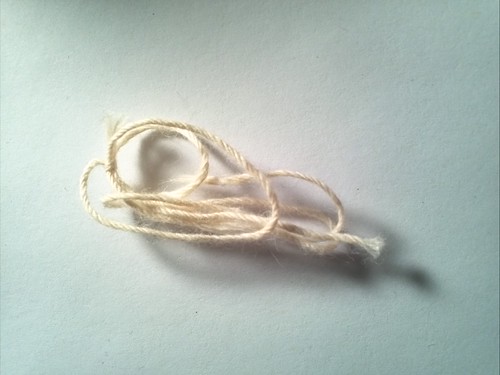
I had a middle school English teacher (Hi, Mrs. Slegers!) who once encouraged us to keep a folder of "pieces of string." I don't know why she used that analogy. All the little snippets of writing that we would start--maybe without ever intending to finish them--were "pieces of string." Some of them were too short to save, but she said things like, "You never know when that little piece of string will come in handy."

Tuesday, November 20, 2012

Wikipedia for School Work?

Oh, Wikipedia...what shall we do with you?

I'm so torn. I use Wikipedia myself regularly. But...not for academic work. What is a teacher to do?

This piece came up in my Twitter feed yesterday. It's a pretty thoughtfully written piece, though I'm not thoroughly convinced by his arguments.

Of course, I had a piece published back in the Spring of 2011 that basically makes the same argument (you can read it on pp12-15), but I was thinking more of elementary, middle, and high schools here.

Why does it feel different in Higher Ed? Because I clearly advised my freshmen in Intro to Education to not use Wikipedia as a source for a recent research project.

Do I need to get over myself here? I'd love to hear your thoughts on this...


Monday, November 19, 2012

Alternatives to PowerPoint

If you are the teacher who assigns students to create PowerPoint presentations to show what they have learned, consider a few alternatives. This is on my mind because my students in Intro to Education are  giving presentations on school reform and some historical topics in education, and one of the requirements is to use technology to create visual aids...and I'm encouraging them to try something other than the PowerPoint they've always used.

So here they are: three alternative technologies you might consider:


1. Prezi

You must at least check out Prezi. It's a zooming, swooping alternative to PowerPoint. You can check out a sample presentation I created as an exemplar for my Intro to Education students here.

A couple things I love about Prezi:

Monday, November 12, 2012

13 Chapter Books All Kids Should Read

Earlier this fall, I ranted about reading incentive programs. (I have some pretty strong negative feelings about such programs.) In that earlier post, I referenced one of my favorite books, Twenty and Ten. A friend reported that after reading my post, she picked up a copy for her kids, who loved it (hooray!) She asked me for further recommendations...so here they are, my bakers-dozen of chapter books that all kids should read. In my mind, these would make great read-alouds for the 2nd-4th graders (with a few exceptions that I'll note), or independent readers for the 5th-8th grade crowd. They are presented in no particular order.


1. Chasing Vermeer, by Blue Balliet

Chasing Vermeer is a fantastic mystery-adventure--think of it as The DaVinci Code for the tween set. Here you meet Petra and Calder, unlikely 6th grade friends who are swept up in an investigation of art theft. You'll learn a lot about the famous renaissance painter, Jan Vermeer and some of the controversies related to his work, but it's wrapped up in hidden pictures, secret codes, and a quirky storyline that will capture the interest of pretty much every child to whom I've recommended this book. One of my very favorite books all around--not just kids' books!

Friday, November 9, 2012

Discrepant Events: A Science Magic Show!

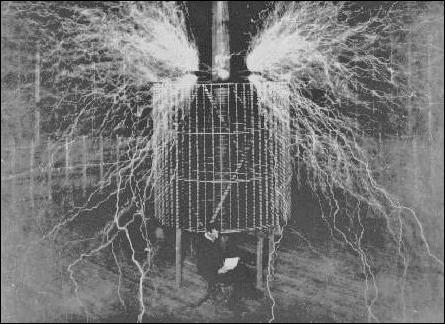
Have you ever heard of Nikola Tesla? His story is fascinating, and sad. Suffice to say, the man was a scientific genius ahead of his time. I've read that scientists are still trying to figure out how he did some of the things he was able to do with electricity. Check out this picture of him sitting calmly in his laboratory while man-made lightning bolts crackle around him! The guy was a science magician.

Nikola Tesla, Science Magician


I should have had my camera in class for my Science Methods class this past Wednesday night. I had assigned my students to come up with discrepant events--science "magic tricks" you might say--and present them in class. No Nikola Tesla in our class, but they were pretty amazing demonstrations none-the-less...and definitely great for getting their future students interested and curious in science concepts!

Warning: the following paragraph includes a lot of educational jargon. If you don't care about educational jargon, skip down a paragraph. :-)

Discrepant events are a pretty powerful way to engage students in the processes of doing science. The basic idea is that you will demonstrate some sort of phenomenon that has a surprising or unexpected outcome. Educational psychologists would say these sort of events "prompt cognitive dissonance." In other words, they make your brain say, "Wait...what just happened?" and cause you to start asking questions and trying to infer what might be causing the phenomenon. This gets at all kinds of promising practices for teaching science, including identifying misconceptions, tapping students prior knowledge, and engaging in authentic inquiry.

Okay, enough of the education mumbo-jumbo...on to the fun! In class this week, all 26 of my students came with a crazy discrepant even prepared. No lie, we had people setting dollars dipped in rubbing alcohol ablaze, people standing on egg shells, and--the show-stealer of the night--grapes in a microwave...which arced with energy and burst into flame. (Okay, maybe we do have a Tesla!)

It was a lot of fun, and the students seemed genuinely excited and impressed with each other's work. Most indicated that after practicing an presenting a discrepant event of their own--not to mention seeing 25 others performed for them!--they would be much more likely to use these sorts of things in their own classroom. That swells me with joy!

Then, this morning, my friend Josh shared this link to the Exploratorium with me. Here you can find a whole bunch of great ideas for possible discrepant events! Definitely one I'll share with my students next semester.