Thursday, January 31, 2013

Geographic Ignorance

I was talking with a friend and fellow teacher the other day and she was sharing how appalled she was at her students' lack of geographic awareness. Can't find Paraguay on a map. Not sure where Normandy is. No clue where the Romans were from. We sort of laughed about it. But our laughter was the hollow sort where you are confronted with something so unbelievable you can either laugh or cry.

C'mon people...the Romans? Ugh. Geographic ignorance is rampant in America.

I'm sort of fascinated by people's lack of geographic awareness. Given how interconnected global events have become, you would think people would be more interested and aware of how geography shapes culture, and politics, and economics, and a host of other aspects of our modern life.

Image courtesy freedo
I think this should put a burden on schools to do a better job of increasing students' global awareness. I know the curriculum is already overstuffed--that's another whole blog post in the making. It surely would take some pruning of the curriculum to make room for teaching more geography, culture studies, and world languages, but I think these are only going to be of increasing importance.

Here's a fun little map quiz for you that I found online today. Just 15 countries for you to find where they belong on the map. My challenge: time yourself and see how long it takes you to figure out which one is which. If you're feeling really brave, comment on this post with your time to match all 15 countries.

What do you think? Am I blowing this out of proportion? Or is this a real shortcoming for 21st Century citizens?

Wednesday, January 30, 2013

Do Old School Methods Still Make Sense?

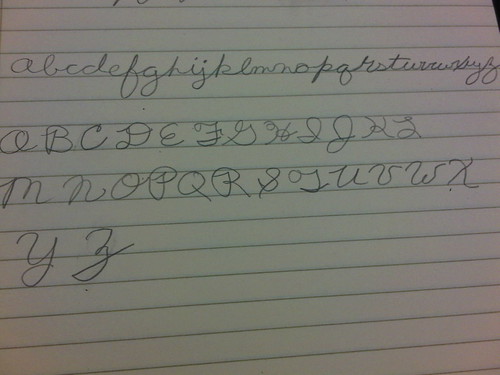
I probably abuse the phrase "old school" by using it a little too frequently. But Annie Murphy Paul's article I read today is talking about the benefits of actual old school methods, as in...methods from school in days of yore. She's talking about stuff like recitation (reading aloud), penmanship (cranking up the cursive), rhetoric (developing an argument), and rote memorization (kill and drill math facts, anyone?)

I found this interesting, and challenging, because I tend to think that many of these methods are falling out of favor. Or at least, they are falling out of favor with me.

Image courtesy Daphne Abernathy
CC BY-NC-SA 2.0
For instance, I have argued against continuing to teach cursive. I think this is a skill that simply isn't as useful in the 21st Century as it was in ages past. (Of course, when I took the GRE recently, I had to copy a paragraph in cursive before taking the test. That took me about as long as one of the test sections...because I never use cursive!) But I tend to think that it's important that kids can communicate clearly in writing; whether that's print or cursive is less important to me.

Tuesday, January 29, 2013

Twitter as a Key Part of Your PLN

I'm a guest blogger last month and this month at Christian Schools International's Nurturing Faith blog. Always great stuff there for Christian teachers to read and reflect on !

Anyway, my two-part piece was on getting teachers to use Twitter as a part of their personal learning network (PLN.) Many teachers are, of course, already doing this. But few of the teachers with whom I have regular contact (outside of Twitter!) are using Twitter in this way. I would like to see more folks benefit the way I have from following interesting people and developing a PLN to whom they can turn for ideas and conversation.

Sunday, January 27, 2013

Books for Boys: 3 Realistic Fiction Titles too Good to Pass Up

Three very different stories here, but all in the realm of realistic fiction, and all books that I was able to use to hook middle school boys...

1. Crash by Jerry Spinelli
"Crash" is John's nickname, and it fits him perfectly. A cocky middle school football star, he crashes through every part of his life, on and off the field. His geeky classmate, Penn, is a common target, but Penn's unconventional way starts to affect Crash in a way he didn't expect. And when a shock at home sets his life reeling, John begins to see that crashing through people might not be in his best interest after all.

A compelling story of popularity and bullying that hooked middle school boys without exception!

Friday, January 25, 2013

Fantastic Contraption: A Physics Simulation

Okay, it's a game. But it'll teach your students some physics concepts and problem-solving strategies in the midst of playing a game. (And who ever said you can't learn anything by playing a game?)

Thursday, January 24, 2013

Attributes of Effective Teachers

I think one of my colleagues has assigned our students to query teachers about what makes an "effective teacher." (GREAT assignment, in my mind.) Several of my former Intro to Education students have contacted me today asking me about my thoughts on this.

One student framed the question this way: "Would you be able to send me a list of 10 words that effective teachers should possess? Preferably in order from most important to least."

So I did. (Sucker that I am...)

Here's my list of key attributes for effective teachers: