Thursday, October 31, 2013

Always Reforming...

By Lucas Cranach [Public domain]
via Wikimedia Commons
Today is October 31st. In Protestant circles, it's a big day: Reformation Day. On this day we celebrate a German Roman Catholic priest and professor who went rogue back in 1517. On this day, almost 500 years ago, Martin Luther kicked off a domino rally that began another whole branch of the Christian Church. Luther wasn't the only one...folks like Zwingli, and Calvin, and Huss, and a host of others were part of this reaction to the practices of the Roman Catholic Church

The very name "Protestant" indicates a mindset for these early reformers. They were protest-ant; they were boldly speaking out against things they saw as needing change. The history of Protestantism is full of protest of injustice and against heresy. The Reformation is all about reforming--not replacing, mind--what is broken.

Wednesday, October 23, 2013

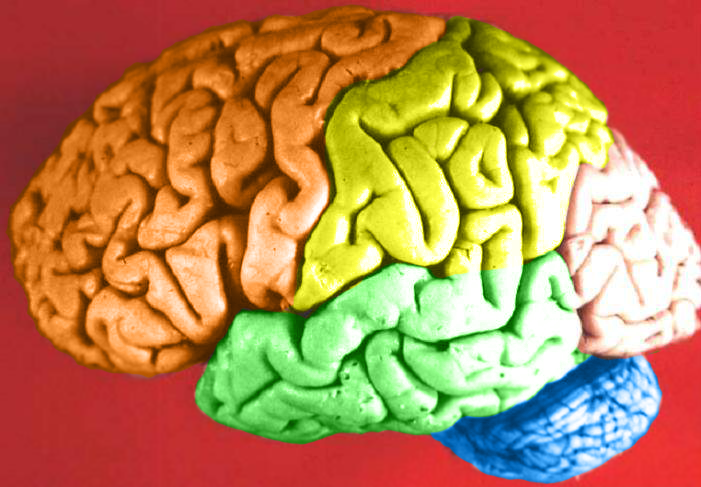
Multiple Intelligences are Not Learning Styles

Image from Wikimedia Commons [CC BY 2.5]
Last week I wrote some of my thoughts about learning styles--and how they probably don't actually exist. I was pretty stunned when I originally read the research about this, but as I'm thinking more and more about it, I'm finding myself in agreement.

But my next question is about Howard Gardner's theory of Multiple Intelligences, which I have closely equated to learning styles, in practice at least, and when I'm honest, in my thinking as well.

Gardner's theory of Multiple Intelligences, in a nutshell, expresses that intelligence is not a unitary trait; that is, intelligence is not something you have or don't have. Traditionally, this is how intelligence was described: either you are intelligent (you smartypants, you) or you are unintelligent (hey, dummy!) (That's pretty nasty, isn't it? Sorry.)

Monday, October 21, 2013

Limiting Creativity With the "Correct" Answer

My friend and classmate, Susan Shannon, shared this with me the other day. She was at a session presented by creativity guru Ken Robinson and he shared this video with the group. It is stunning, and I think the video speaks for itself...so I'm not going to say any more. If you are a teacher or if you have kids in school, please watch this.


Sunday, October 20, 2013

Bad Advice from Yoda and the Power of "Yet"

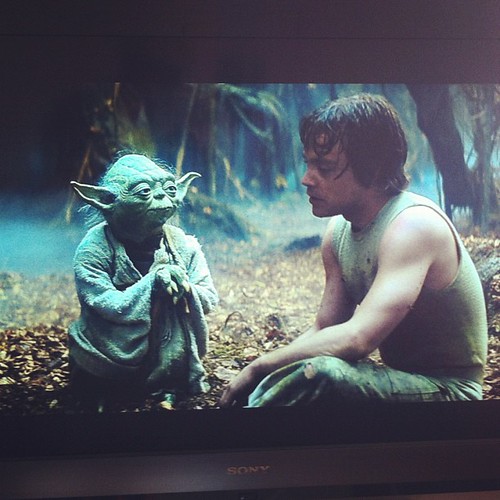
I love Star Wars. (Waving my geek flag proudly here...) One of my favorite scenes from The Empire Strikes Back is a moment between the aged Jedi master, Yoda, and his young apprentice, Luke Skywalker. Luke is training, doing his best, struggling to get it figured out. He is faced with a tremendously difficult task--lifting his huge spacecraft out of the swamp where it is crashed--and expresses his willingness to give it a try, his diminutive-but-powerful teacher makes this audacious statement:

Image by Blacren CC BY 2.0
Do, or do not. 
There is no try.

I love that line. It sounds so truthy, and it's so quotable. It speaks of resolve, and determination, and not settling for less than your best. I think it's likely that teachers might be tempted to follow Master Yoda's lead and challenge their own students this way.

But I'm afraid that might be a mistake.

Saturday, October 19, 2013

Nine Things Schools Should Consider When Creating a Technology Plan

I recently received an email from a friend who is on the school board of a smaller Christian school. Knowing that I have a lot of opinions about educational technology, he asked me for some advice: their school is developing a technology plan for the next five years and want to plot things out well so it will be successful.

I was really glad to hear that. I think many schools just go blundering into the realm of technology and don't have a well-reasoned plan for how to design how technology will be infused into the classrooms.

So after some thought and reflection, here's my advice: nine things schools should think about as they create a technology plan:

Thursday, October 17, 2013

Wait...Learning Styles Don't Exist?

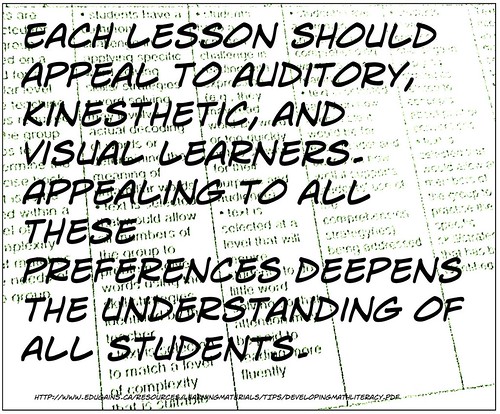
"Each lesson should appeal to auditory, kinesthetic, and visual learners. Appealing to all these preferences deepens the understanding of alll students."
Image by Ken Whytock CC BY-NC 2.0

Have you heard statements like the one on the above graphic before? If you are a teacher--and even if you aren't--I'm guessing you've heard this argument. Because it's pretty clear that people learn in different ways, right? I mean, some kids learn best by seeing it (visual learners) while others learn better by hearing it (auditory learners) and still others learn best by doing it (kinesthetic learners.)

I've basically believed that idea and taken it as a fact into my teaching practice for...pretty much my entire teaching career.

Wednesday, October 16, 2013

Web 2.0 as a Platform for Formal Learning?

Image by Gavin Llewellyn CC BY 2.0
Do you remember the first time you were on the World Wide Web? I do. It was 1995, and I was a sophomore. A friend at the University of Michigan emailed me, “Hey, check out my webpage!” And I responded, “What’s a webpage?” (It was 1995, okay? The WWW was basically brand new...) He gave me some instructions, and after finding a suitable computer, and typing in a ridiculously long URL, I was greeted by a picture of my friend Jon in a tie-dyed shirt (as always), playing his guitar. I was totally enamored with this new technology! I can say with some honesty that I spent a lot of time "surfing"--as we called it then--from one page to another.

Of course, this was Web 1.0. In 1995 the World Wide Web was still in its infancy. There was no such thing as Google. (Can you imagine?) "Jerry and David's Guide to the World Wide Web" was only recently renamed "Yahoo!" and was still being managed by hand. (Can you imagine?) Mark Zuckerberg may have been dreaming about Facebook, but he was only 11 years old. The World Wide Web was a very different place.